
Our Rating

Walla Walla
60% Cabernet Franc, 40% Cabernet Sauvignon
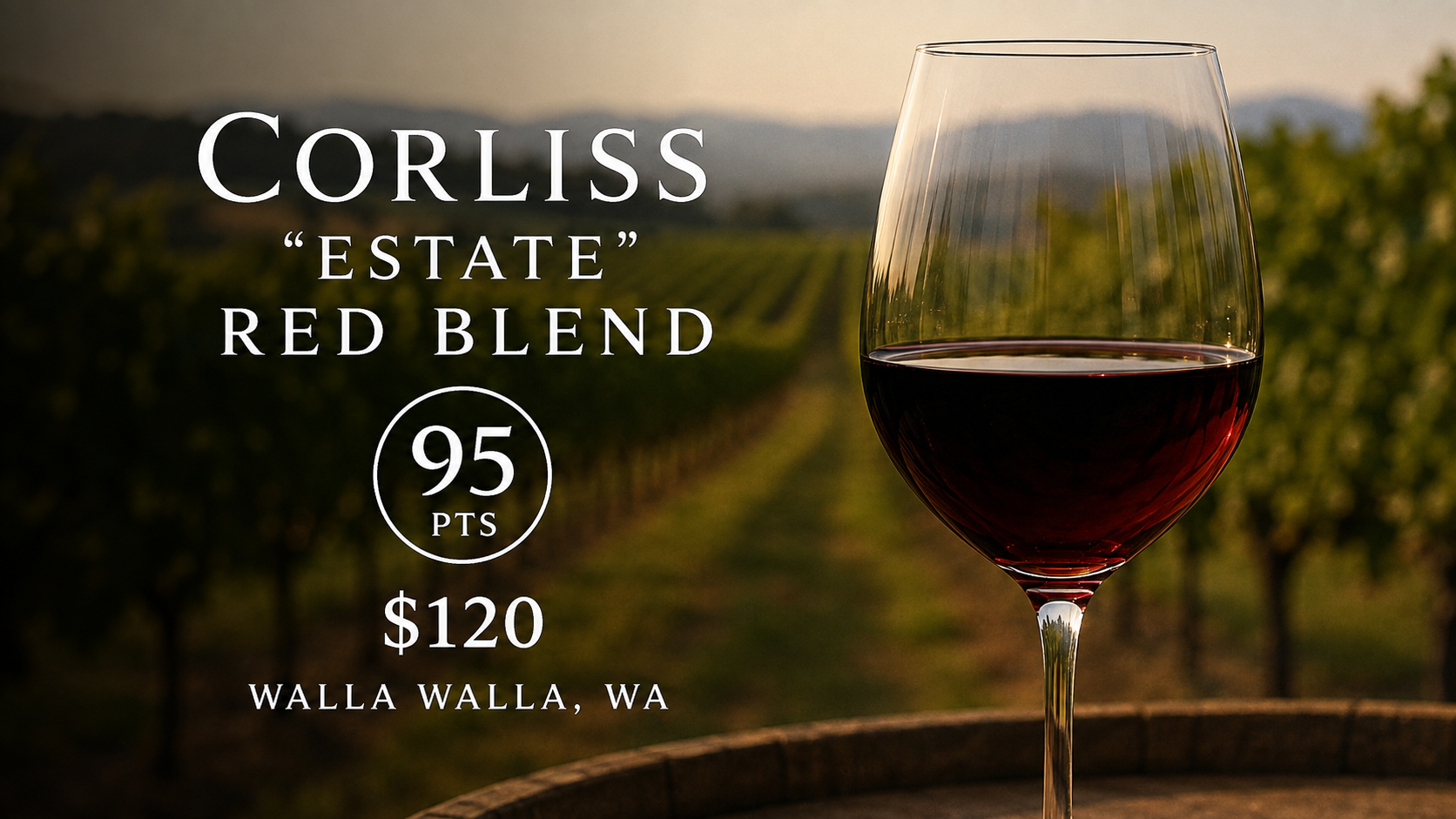
Corliss Estates Red Wine 2020 is a Washington Bordeaux-style blend composed of 60% Cabernet Franc and 40% Cabernet Sauvignon. The wine was released to Corliss Registry members in August 2025, nearly five years after the vintage, reflecting the producer’s practice of holding wines for extended maturation before release.
The 2020 bottling combines ripe black fruit with considerable tannic structure and a pronounced oak-derived character. Cabernet Franc takes the lead in the blend, giving the wine a somewhat different framework from a Cabernet Sauvignon-dominant Washington red. The result is concentrated and full-bodied, with enough structure to support additional bottle development.
Michael and Lauri Corliss established Corliss in Walla Walla in 1999, and the winery developed around a deliberately slow production and release model. Corliss emphasizes meticulous vineyard work, individual berry sorting, small-scale fermentation, extended barrel élevage, and more than two additional years of bottle aging before release. The wines are currently sold exclusively through the winery’s Registry program.
The producer works primarily with red varieties suited to eastern Washington, particularly Bordeaux grapes and Syrah. Its approach places significant weight on vineyard selection, extended maturation, and blending rather than rapid movement from harvest to market. That extended schedule is particularly relevant to the 2020 Red Wine, which did not reach Registry members until August 2025.
Corliss does not frame its winemaking around a single individual. The winery describes the process as a collaborative effort, with Michael and Lauri Corliss closely involved in establishing and maintaining the house style alongside a professional winemaking team. Atelier Melka also serves as a consulting winemaking partner.
This team-based model is consistent with the winery’s emphasis on selection and patience. Native yeast fermentation, small-scale oak and concrete fermenters, extended barrel aging, and lot selection are all part of the broader Corliss production approach. Vintage-specific details should still be distinguished from general cellar practices when the winery does not explicitly document them for a particular bottling.
Corliss farms several estate vineyard properties in eastern Washington. Its Red Mountain holdings include an original 33-acre vineyard purchased in 2007, a larger property known as The Canyons, and an adjacent parcel acquired in 2012. The company also farms Blackrock Vineyard on the eastern edge of the Yakima Valley AVA, where Bordeaux varieties are among the grapes planted.
The winery states that its estate vineyards are sustainably farmed and that fruit is hand-picked and hand-sorted. However, the current producer page for the 2020 Red Wine does not identify the specific vineyard parcels used in this particular blend. For that reason, assigning the 2020 bottling to individual estate vineyards would go beyond the vintage-specific information Corliss currently provides.
The most important confirmed technical detail for the 2020 Red Wine is its composition of 60% Cabernet Franc and 40% Cabernet Sauvignon. Independent reporting on the vintage also states that the wine spent 22 months in French oak, with approximately 55% new oak.
That élevage helps explain the substantial cedar, vanilla, cocoa, espresso, and baking-spice elements present in the tasting profile. Corliss generally employs slow native yeast fermentation and extended barrel aging followed by prolonged bottle maturation, although the producer does not provide a complete fermentation protocol for this individual 2020 bottling on its current wine page.
Washington’s 2020 growing season was relatively warm but produced a substantially smaller crop than average. Heat spikes occurred in late July and early August, followed by hotter weather at the beginning of September. Wildfire smoke arrived during the second week of September and temporarily slowed harvest activity, although early industry reports indicated that negative smoke effects were limited in many wines.
Washington ultimately harvested approximately 178,500 tons of wine grapes in 2020. Smaller berries, lower yields, and additional hang time contributed to concentrated fruit and deep color in many red wines, though conditions varied by vineyard and harvest timing. These statewide conditions provide useful context for the vintage, but they should not be interpreted as evidence that this particular wine experienced smoke-related issues.
The wine shows a clear, deep ruby appearance with substantial color concentration. Its depth is consistent with the dense structural profile that follows on the nose and palate.
The aromatic profile is pronounced and youthful, led by blackcurrant, blackberry, and plum. Cedar, dark chocolate, tobacco, vanilla, and baking spice add a strong secondary layer, while graphite gives the nose a darker mineral edge. The fruit remains prominent, but oak and savory elements are already integrated into the broader aromatic profile rather than appearing completely separate.
Dry and full-bodied, the palate combines blackcurrant, blackberry, and plum with cocoa, cedar, espresso, vanilla, and graphite. Acidity sits at medium-plus, providing needed lift against the wine’s concentration and elevated alcohol impression. Tannins are high and firm but polished, reinforcing the wine’s structural focus without overwhelming the ripe fruit.
There is considerable flavor intensity through the mid-palate, with dark fruit gradually giving way to cocoa, coffee, cedar, and mineral notes. The wine remains youthful in structure, and the combination of tannin, concentration, and fruit suggests that further bottle development should allow the components to integrate more fully.
The finish is long and savory, carrying black fruit, cocoa, cedar, tobacco, and graphite beyond the main palate. Tannin remains evident through the close, giving the wine a firm final impression rather than a soft or quickly tapering finish. Several hours in a decanter are appropriate when opening the wine in its current stage of development.
Corliss Estates Red Wine 2020 is a concentrated, Cabernet Franc-led Washington red built around ripe black fruit, substantial tannin, and pronounced savory and oak-derived complexity. Cedar, cocoa, espresso, tobacco, vanilla, and graphite give the wine a darker secondary profile, while medium-plus acidity provides enough freshness to keep the full-bodied structure in proportion.
The wine can be approached now with several hours of decanting, but its tannic framework and fruit concentration support continued cellaring. A drinking window of approximately 2025 through 2045 is reasonable based on the structure observed in the tasting, with the wine likely to become more integrated as the tannins and oak continue to resolve.

USA
Walla Walla
60% Cabernet Franc, 40% Cabernet Sauvignon
14.9%
Michael and Lauri Corliss
1-2 Hours
Now - 2045
Corliss