
The Drinks Business – Bottle Of 1945 Drc Sells For Us$812,500, Setting New World Record
In this The Drinks Business article, Arabella Mileham reports that a bottle of 1945 Domaine de la Romanée-Conti sold for US$812,500 at auction, setting a new world record for a bottle of wine. The bottle had notable provenance, having come from the cellar of Robert Drouhin, and it had already made headlines when Sotheby’s sold it in 2018 for US$558,000. The broader takeaway is that the very top end of the fine-wine market still has buyers willing to pay astonishing sums for rarity, provenance, and historical significance, even in a softer and more selective broader wine market. From the article:
Other highlights of the sale included a Methuselah of 1971 La Tâche and twelve bottles of 1999 Romanée-Conti, in original packaging, which achieved $325,000 each; a Methuselah of 1999 La Tâche in its own wooden case, which raised $187,500; a six-magnum case of 2005 DRC Assortment ($162,500); a Methuselah of DRC 1996; a bottle of DRC 1943, and a magnum of 1971 Romanée-Conti, which all achieved $137,500. Meanwhile, the highest-priced white Burgundy of the sale, was Domaine d’Auvenay, with six bottles of 2013 Chevalier-Montrachet in their its own wooden case achieving $125,000.
Ted Hall’s “Tell the Truth and Do the Right Thing” – Napa’s Luxury Squeeze
So, I found one of my favorite new substacks, Ted Hall’s “Tell the Truth and Do the Right Thing”. In this post, he argues that Napa Valley’s current stress is less a normal downturn than a structural luxury-market squeeze created by too many wineries chasing the same narrow premium position at the same time. Hall’s core point is that a large swath of Napa’s smaller producers adopted luxury cost structures, hospitality expectations, and $100-plus bottle ambitions without building the kind of brand pull or differentiation that true luxury markets require. He points to a crowded middle tier, overbuilt tasting capacity, weakening score power, and a direct-to-consumer model under pressure, all of which combine to leave many wineries looking polished on the surface while struggling underneath. The practical takeaway is sharp: Napa may not have a simple demand problem; it may have a brand-density and positioning problem that the region can no longer hide behind prestige alone. This is a long read, so no article quote here. Just head over and read it!
The Drinks Business – Us Wine Drinkers Turn To Value Bottles As Consumption Softens
In this The Drinks Business article, James Bayley reports that a new survey of 1,351 American wine drinkers suggests U.S. consumers are becoming more price-sensitive and more restrained in how much wine they drink. The piece says affordability and moderation are reshaping buying habits, with more attention shifting toward lower-priced bottles, some growing openness to ready-to-drink alternatives, and even a tentative role for AI tools in wine discovery. The bigger indu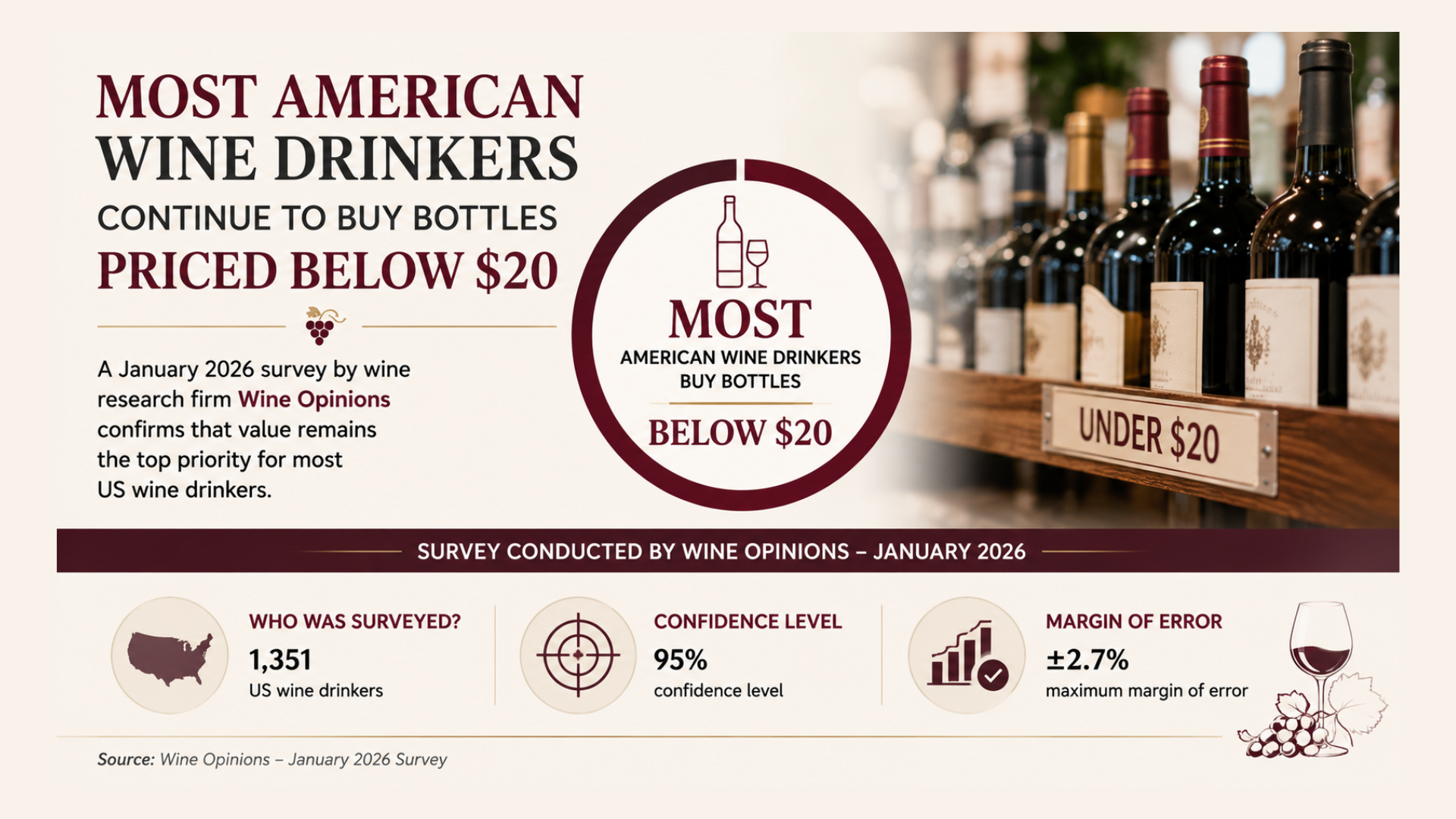 stry takeaway is that this is not just a downtrading story; it is a broader signal that wine is facing pressure on both value perception and relevance, especially as consumers weigh cheaper options and drink less overall. From the article:
Most American wine drinkers continue to buy bottles priced below $20, according to a January 2026 survey conducted by wine research firm Wine Opinions. The study gathered responses from 1,351 US wine drinkers and reported results at a 95 per cent confidence level with a maximum margin of error of plus or minus 2.7 per cent.
More than half of respondents in every age and gender group said they purchase wines priced under $20 on a weekly or monthly basis. Purchases of wines priced under $15 are particularly associated with younger consumers aged 21 to 39.
Frequency falls as price rises. While 54 per cent of respondents said they buy wines under $15 weekly or monthly, only 28 per cent reported buying bottles priced at $30 or more at the same frequency.
Eric Asimov, New York Times, Paywall – How To Find Great Values In Wine – Eric Asimov, New York Times, Paywall
In this New York Times piece, Eric Asimov argues that wine value is not about buying the cheapest bottle; it is about spending intelligently based on your budget, priorities, and what you want from wine. He notes that the old $15 to $20 sweet spot for exciting bottles has shifted upward, and that $20 to $30 today is what $15 to $20 used to be, especially as inflation, tariffs, and restaurant markups reshape pricing. Asimov’s practical advice is to look beyond famous regions and well-known producers, because real value often comes from less celebrated places and emerging names before wider demand pushes prices higher. For readers, the core takeaway is simple: value still exists, but finding it now requires more flexibility, more exploration, and a clearer sense of your own spending limits. From the article:
For years, I have argued that, to spend the least amount of money, the greatest proportion of good values in wine were in the range of $15 to $20 a bottle.
For a little more money, up to $20, I’ve believed, the range of exciting wines increases exponentially.
This has been true for a long time, but in the nearly 15 years since my first list of $20 bottles, the cast of wines has changed drastically. The bottle of Chablis from Domaine Picq that cost $20 in 2012 now costs $35 to $40, while the Langhe freisa from G.B. Burlotto now runs $45 to $50.
He then list some great value regions, but you’ll need to read the article for that. He ends with:
Value is out there. It requires being open to new grapes, different regions and unknown producers but the rewards are worth it.
Phillip Staehle, the visionary behind Enkidu Wine, has been immersed in the world of wine since his youth. His passion was ignited early, curating his own wine collection at just 18 years old. Staehle brings a deep respect for the winemaking process, focusing on minimal intervention and allowing the vineyard to speak through the wine. His approach blends traditional techniques with modern insights, ensuring that each bottle reflects the nuances of Sonoma’s climate and soil. The result is a portfolio of wines that are both approachable and complex.
Gundlach Bundschu “Vintage Reserve” Cabernet Sauvignon 2019

While Napa Valley often steals the spotlight for California Cabernet Sauvignon, this Vintage Reserve underscores Sonoma’s capacity for producing wines of comparable quality with a distinct sense of place. The cooler climate and diverse soils of Sonoma lend this wine a freshness and complexity that balance its inherent power.
The Gundlach Bundschu Vintage Reserve 2019 is a testament to what Sonoma can achieve with careful vineyard management and masterful winemaking. At $142, it represents a worthwhile investment for serious collectors and connoisseurs. Its ability to dazzle now and age gracefully for decades makes it a versatile addition to any wine cellar. Whether enjoyed today with a celebratory meal or laid down for a special occasion in the future, this wine is sure to impress.

Bottega Angelina is the upscale-casual Italian restaurant and market that Orange County needs. This Laguna Niguel restaurant has it all: artisanal food, a unique wine list, an excellent view, and a market with gourmet Italian food staples.
Built in the 19th century as a working citrus packing house, Stonehouse is one of Santa Barbara’s most storied dining destinations — recently honored as the #1 Restaurant in Santa Barbara by OpenTable and recognized by the MICHELIN Guide. Dine indoors by a wood-burning fireplace, on the ocean-view terrace beneath twinkling lights, or within one of our intimate private dining spaces. Every dish draws from the chef’s organic garden steps from the kitchen, where herbs, citrus, and seasonal produce are harvested daily.