
Wine-Searcher – Consumers Reject Expensive Restaurant Wines
In this Wine-Searcher article, W. Blake Gray argues that restaurant wine pricing is actively turning diners away from the category, not just because of cost, but because the by-the-glass experience often fails to justify the price. Citing new Wine Market Council research discussed at a Napa press event, Gray reports that more than 75% of wine drinkers told NIQ they are unwilling to pay more than $16 for a glass of wine in a restaurant, while only 15% would go above $18 and just 7% would pay more than $20. From the article:
 For 46 percent of wine “non-adopters,” they had a wine they didn’t like more than 11 years ago, and never tried another. Of that group, nearly 60 percent had that bad wine experience more than 21 years ago.
It makes you wonder how many wine drinkers have been lost forever by “natural wine” bars. WMC president Liz Thach said that the wine industry has lost 36 million consumers to beer and spirits because of one bad-tasting wine in the past.
Whatever you do, don’t give a beginning wine drinker a Barolo. Thach said those are absolutely the worst possible wine for newbies: tannic, bitter, austere.
“They want Moscato. They want a soft Chardonnay,” Thach said. “They like a sweet Riesling.”
Big wine companies have figured this out: it’s why wines like Meiomi and The Prisoner sell millions of cases without any praise from the wine media whatsoever.
Drinks International – Catena Zapata Named The World’s Most Admired Wine Brand For Second Year Running By Drinks International
In this Drinks International article, Eleanor Yates reports that Argentina’s Catena Zapata has been named The World’s Most Admired Wine Brand 2026 for the second consecutive year. The Mendoza producer also took Most Admired Wine Brand in South America, while Antinori was ranked second and named the top brand in Europe, with Familia Torres rounding out the top three. The ranking is based on votes from an academy that includes sommeliers, buyers, wholesalers, Masters of Wine, and wine writers, making the result a useful signal of global trade and brand prestige, even if it is ultimately still an industry popularity ranking rather than a consumer sales measure.
The list is VERY tilted toward the old world.
Top 10 from the list:
US wines by rank: 34. Ridge, US. 47. Opus One, US |
Here’s the country count from the 50-brand list:
|
SevenFifty Daily – A Guide to Germany’s New Wine Classification System
In this SevenFifty Daily article, Jim Clarke explains Germany’s updated wine law, a reform that has been phasing in since 2021 and becomes mandatory from the 2026 vintage, shifting the country further toward a geography-based labeling model aligned with broader EU wine rules. The system introduces PGIs and PDOs, with Qualitätswein sitting inside the PDO framework, and it gives Germany’s regional producer groups, the Schutzgemeinschaften, more authority to define grape varieties, production rules, and tasting-board standards within their areas. The article’s key 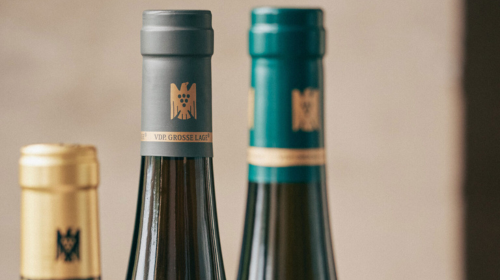 takeaway is that German wine labels may become more internationally legible in theory, but not necessarily simpler in practice, because the new hierarchy adds another layer of regional control and classification on top of an already complex system. From the article:
So while the language on the label may become more recognizable overall, German wine isn’t getting any simpler.
“They set up this new German wine law to harmonize with the EU wine law and now we are coming to the end of the transition, but a lot of questions have popped up,” says Thomas Loosen, managing director of Dr. Loosen winery in the Mosel.
Perhaps the most contentious point in the new plan concerns the top tiers of single-vineyard wines…
The new law includes some barebones rules for the two tiers; for both, the grapes must be harvested by hand, the wines must be dry, and they must meet specified minimum alcohol levels, maximum yields, and minimum aging before release.
Wine-searcher – Inside The Great Judgement of Paris Makeover
In this Wine-Searcher article, Vicki Denig reports on a modern recreation of the 1976 Judgment of Paris tasting, with the U.S. again coming out on top, but with a noticeably updated frame around what wine competition is supposed to measure. The piece centers on Patrick Cappiello and his push to spotlight American wine at a moment when many domestic producers feel both consumers and trade buyers have cooled on the category. The bigger point is that this was not just nostalgia for one of wine’s most famous tasting events, it was an attempt to re-stage the conversation around American wine quality, relevance, and identity in today’s market. From the article:
(Patrick) Cappiello took to social media and encouraged his followers to join him in drinking only American wines for a two-month period, both to create momentum for struggling producers and expand his own horizons; what he discovered blew him away. “The quality of the wines  that I was tasting – not just from California, but from New York, Virginia, and Pennsylvania – was unbelievable,” he said, revealing that he was constantly impressed by what I was opening. One night during his tasting journey, Cappiello’s partner suggested watching Bottle Shock, a 2008 film based on the 1976 Judgment of Paris tasting. The rest was history. “I thought, oh my god, I should really recreate this tasting,” he said. And so began the two-year journey of The 1976 Redo.
Which brings us to earlier this week, where I was asked to participate as a judge at the event. Joined by 11 industry colleagues, our group packed into the back room of Smithereens (NYC) restaurant at 9 am to begin the tasting journey – which is genuinely what I believed this to be, more so than a “competition,” per se. The room featured four small tables, each with three simple place settings – 10 glasses, a notepad, and a few spit cups scattered about. Our proctor, the venerable Pascaline Lepeltier, had already been on site for God knows how long before our arrival, popping, preparing, and pouring each of the 40 wines in question.
Calcareous Vineyard in Paso Robles, CA
We found the wines at Calcareous Vineyards to be good but not great. Having said that, the property and the tasting room are beautiful, and there are worse ways to spend a day than sipping decent wine atop a hill overlooking the valley and vineyards. The lunch menu and the tasting line-up was good enough that we would recommend a visit.
All in all, this was still a nice way to spend an afternoon in Paso Robles wine country.
Venteux Vineyards Petite Sirah 2017

The 2017 Venteux Vineyards Petite Sirah is a tannic wine with a lot of texture. The wine is a lovely brooding shade of reddish-purple in the glass, and the nose is classic Petite Sirah. We picked up dark pitted fruit and black fruit, concentrated spices like cedar and black tea, and undertones of licorice, eucalyptus, and a pleasant aroma of dark chocolate.
This wine has a generous palate and a long, satisfying finish that lingers. Luscious dark fruits like blackberry and cherry hit on the first wave, and those are followed with rich notes of chocolate, sneaking eucalyptus, and violet. There’s also a nice punch of black pepper here.
A Crystal Cove Restaurant: Glitzy Newport Beach Dining

A Crystal Cove restaurant in Newport Beach breathes new life into a historic California space along the Coast Highway. The classic menu, buzzy bar scene, and old school decor, make this one of Newport Beach’s best destination restaurants.
Everything we ordered at A Crystal Cove was excellent, and this Newport Beach hot spot easily makes our list of Orange County’s best restaurants. RJ, our server, was friendly, knowledgeable, and on-point the whole evening. We recommend you come in for a cocktail, a glass of wine, or a meal.
Corkage Fee: $45.00 Per Bottle / Max 2
Montecito, CA
4.8 Stars with over 400 Reviews
Lucky’s is a high-end old-school steakhouse in Montecito. It’s been open for 25 years. The vibe is classic American steakhouse: white tablecloths, vested servers, framed photos of Sinatra and Sammy Davis Jr. The menu covers the usual suspects done well: wedge salads with Roquefort, jumbo shrimp cocktail, filet mignon with peppercorn sauce, and oversized martinis.