
The Spiritz Desk reports that France is moving forward with one of the most significant state-backed vineyard reduction programs in recent memory, with roughly 28,000 hectares (over 69,000 acres) of vines set to be uprooted under a scheme managed by FranceAgriMer. The program has drawn approximately 5,800 applications from growers seeking financial assistance to exit or restructure their operations. Backed by €130 million in funding at a rate of €4,000 per hectare removed, the initiative targets completion by the end of 2026.
From the article:
Most applications come from south-western regions, including Gironde, Aude, Gard, Hérault, Pyrénées-Orientales, and Gers, largely involving red grape varieties. Around 37 percent of the planned removals will see growers exit wine production entirely, while 63 percent involve partial uprooting of vines over 10 years old to enable restructuring.
In a press release distributed via PRNewswire, the Barolo and Barbaresco Consortium announced a strong debut for the Canadian edition of the Barolo and Barbaresco World Opening, held May 12, 2026, at the Liberty Grand in Toronto. The event drew approximately 650 trade and hospitality professionals alongside roughly 150 wine enthusiasts,
making it one of the more substantial European wine trade tastings to land in Canada in recent years. Nearly 170 producers poured more than 350 labels across the walk-around format, organized in collaboration with the Consulate General of Italy in Toronto.
Our take on this:
The timing of this debut is hard to ignore. Canada has sharply pulled back on American wine imports in response to tariff tensions with the United States, and that shift has opened meaningful shelf and list space for European producers looking to deepen their footprint. For the Barolo and Barbaresco Consortium, landing in Ontario right now is not just good timing, it is good strategy. Consortium president Sergio Germano acknowledged that the Canadian market, while historically receptive to Piedmontese wines, requires sustained investment in promotion and communication, especially as the number of competing producers worldwide has grown significantly over the past two decades. The inclusion of a consumer-focused session alongside the trade program signals that the Consortium is not simply courting importers and sommeliers. It is building the kind of direct consumer awareness that turns shelf presence into long-term loyalty, in a market that is actively looking beyond American bottles.
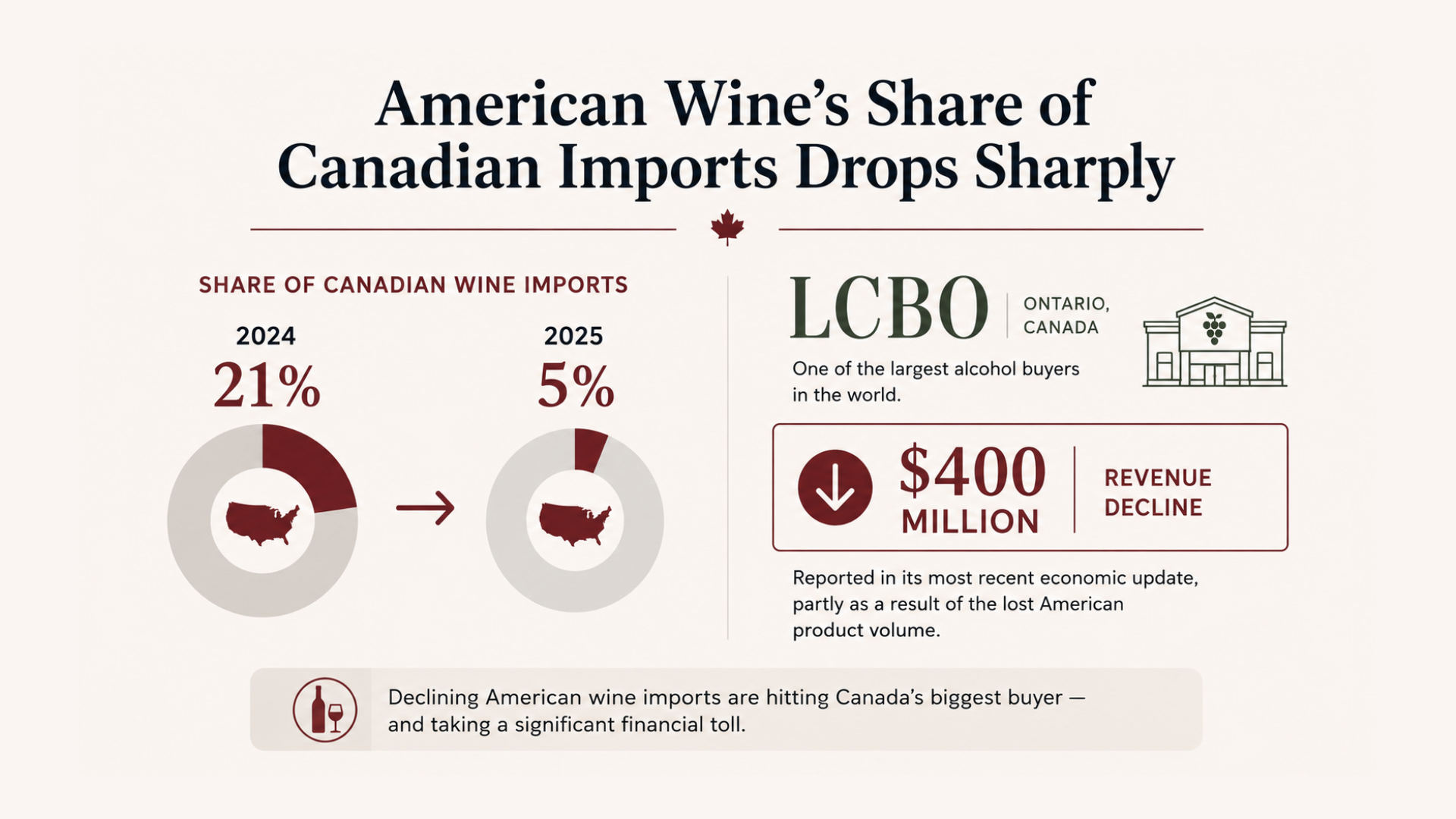
CBC News reporter Graeme Bruce takes a data-driven look at the real cost of Canada’s ban on American alcohol, and for U.S. wine producers the numbers are punishing. When Canadian provincial liquor boards began pulling American products from shelves in early 2025, in direct response to the Trump administration’s 25% tariffs on Canadian goods, it triggered one of the most abrupt market access collapses in recent trade history. American wine’s share of Canadian imports fell from 21% in 2024 to just 5% in 2025. The LCBO in Ontario, one of the largest alcohol buyers in the world, reported a $400 million revenue decline in its most recent economic update, partly as a result of the lost American product volume. The ban has now stretched into a second year, with most Canadians heading into the Victoria Day long weekend without access to American labels for the second consecutive season.
From the article:
According to trade data from the U.S. Census Bureau, wine exports from the U.S. to Canada dropped by $343 million US between 2024 and 2025, a devastating blow to the American wine industry. That represents a 77 per cent year-over-year drop in wine exports to Canada, which was previously the largest buyer of U.S. wine.
… on the flip side…
The U.S. has long enjoyed a trade surplus with Canada, exporting hundreds of millions of dollars more worth of wine than it brings in. However, that surplus has all but evaporated since the start of the trade war. Although Canada’s wine exports to the U.S. are modest, they have held steady over the past two years and have seen substantial growth since 2020.
The Drinks Business reports that the Australian government has dealt a significant blow to the country’s wine sector by phasing out the Wine Tourism and Cellar Door Grant program, effectively cutting AU$10 ($7.2 USD) million per year from one of the only federal support programs wine businesses could access. The decision came as part of the 2026 federal budget, which projects savings of AU$104.6 million over five years through reductions to grant programs of this kind. The grants, which provided up to AU$100,000 per producer, were a direct lifeline for regional wineries relying on cellar door trade and tourism revenue to stay solvent. Treasury Wine Estates CEO Sam Fischer acknowledged the government’s budget pressures but called the loss of the cellar door program a clear “blow” to communities.
From the article – the wine industry responded as expected:
Ben Small, Liberal MP for Canberra suburb Forrest was even more forthright in his response.
“To show how nasty this mob are to regional communities, they canned the AU$10m wine tourism and cellar door programme, originally announced with fanfare and applause,” he said.
“Our wine industry is crucial to the region because of the employment, investment, and the tourism draw that it provides…Of course, the Government found AU$3.7 billion to funnel into Victoria’s Suburban Rail Loop.”
Mia Carta Tasting Room in Napa, CA
This is a really nice tasting room, and if you’re staying downtown, you will love it even more because it’s walking distance from just about every hotel. The prices are reasonable for Napa, especially when you consider a few of the tasting rooms surrounding Mia Carta are double or triple the cost.
We found the service to be a bit hit or miss, and it was no surprise that with so many producers, some were better than others. Overall, we think many wine lovers would enjoy an experience like the one these winemakers have cultivated.
Quintessa Cabernet Sauvignon 2019

If you like bold, layered wines, the 2019 Quintessa delivers in spades. It’s full-bodied with pronounced flavors that mirror the nose: ripe black cherry, blackberry, and black currant up front, followed by savory notes of graphite, cedar, and cigar box. There’s also a hint of black pepper, licorice, and even a touch of olive that adds complexity.
The structure is where this wine really shines. The tannins are high but fine-grained, giving the wine a firm backbone without being too drying. The acidity, while not super high, keeps things fresh and prevents the ripe fruit flavors from feeling heavy. The finish is long and smooth, with all the flavors lingering in perfect harmony.

Compline’s menu is an ode to the fresh produce and vibrant flavors of Napa Valley. Each dish is crafted to perfection, highlighting the essence of its ingredients. While the menu may be ever-evolving to accommodate the freshest produce of the season, the quality and flavor profile remain consistently exceptional.
What sets Compline apart is how it pairs these culinary delights with wines that enhance and complement every bite. Whether you’re indulging in a hearty entrée or sharing small plates with friends, there’s a wine recommendation to elevate your dining experience. From crisp whites to velvety reds, Compline’s wine list is both extensive and expertly curated.
Corkage Fee: $25 Per Bottle / Max 4
Corkage Fee: $25 Per Bottle / No Limit / Can’t be on Wine List
Yountville, CA
4.3 Stars with over 183 Reviews
An integration of food, wine, art, and design, it features an ingredient-driven menu that reflects the region’s relaxed refinement, as well as a selection of wines from esteemed vintners in the United States and Europe. Guests dine in the indoor-outdoor space amidst trickling fountains, heritage olive trees, and glimmering chandeliers.