
The New York Post reports on the deepening collapse in California wine country, where falling demand and chronic oversupply have sent vineyard and winery valuations tumbling and pushed even large producers to shutter facilities and pull vines from the ground. The picture is stark: weak performers saw sales fall roughly 10 percent in 2025, at least a fifth of the state’s grape crop went unharvested, and California’s vineyard footprint has shrunk to around 477,000 acres from roughly 600,000 in recent years.
From the article:
…industry insiders called this downturn one of the toughest in decades. Vineyard owners are now rushing to sell land in a market crowded with sellers and very few buyers.
“It’s like catching a falling knife,” Sonoma-based agricultural land appraiser Tony Correia said of the collapsing vineyard market. “The market’s moving faster than the appraiser does.”
Correia said vineyard owners across Sonoma, Napa Valley, Mendocino, and Lake counties are all feeling the squeeze as grape demand weakens and buyers gain leverage.
“If you’re going to sell in today’s market, you need to face the reality,” he warned. “There’s lots of sellers, and there’s very few buyers.”
In this Wine Business opinion piece, Castle Rock Winery founder Greg Popovich draws on more than three decades in the trade to argue that wine’s competition is no longer beer and spirits. It is everything fighting for a consumer’s time and attention: streaming, social media, food delivery, video games, and above all sports betting apps like DraftKings and FanDuel, which turn a quiet evening into a stream of wagers and notifications. The same $100 that once bought dinner and a bottle now disappears into a parlay from the couch.
From the article:
“The wine business is facing a perfect storm of change. Younger consumers are drinking differently than previous generations. Cannabis legalization has created an entirely new recreational category that barely existed when I entered the wine business. Wellness trends have encouraged moderation. Inflation has squeezed household budgets. Restaurant prices have climbed dramatically.
And then there are GLP-1 weight-loss medications such as Ozempic, Wegovy, Zepbound, and Mounjaro. Perhaps no trend has the potential to reshape consumer behavior more dramatically. Some analysts project that tens of millions of Americans—and potentially as many as 83 million—could eventually use GLP-1 medications.”
The Spirits Business reports a genuine milestone from IWSR’s latest global data release: for the first time since the firm’s records began in 1990, the world drank more spirits than wine 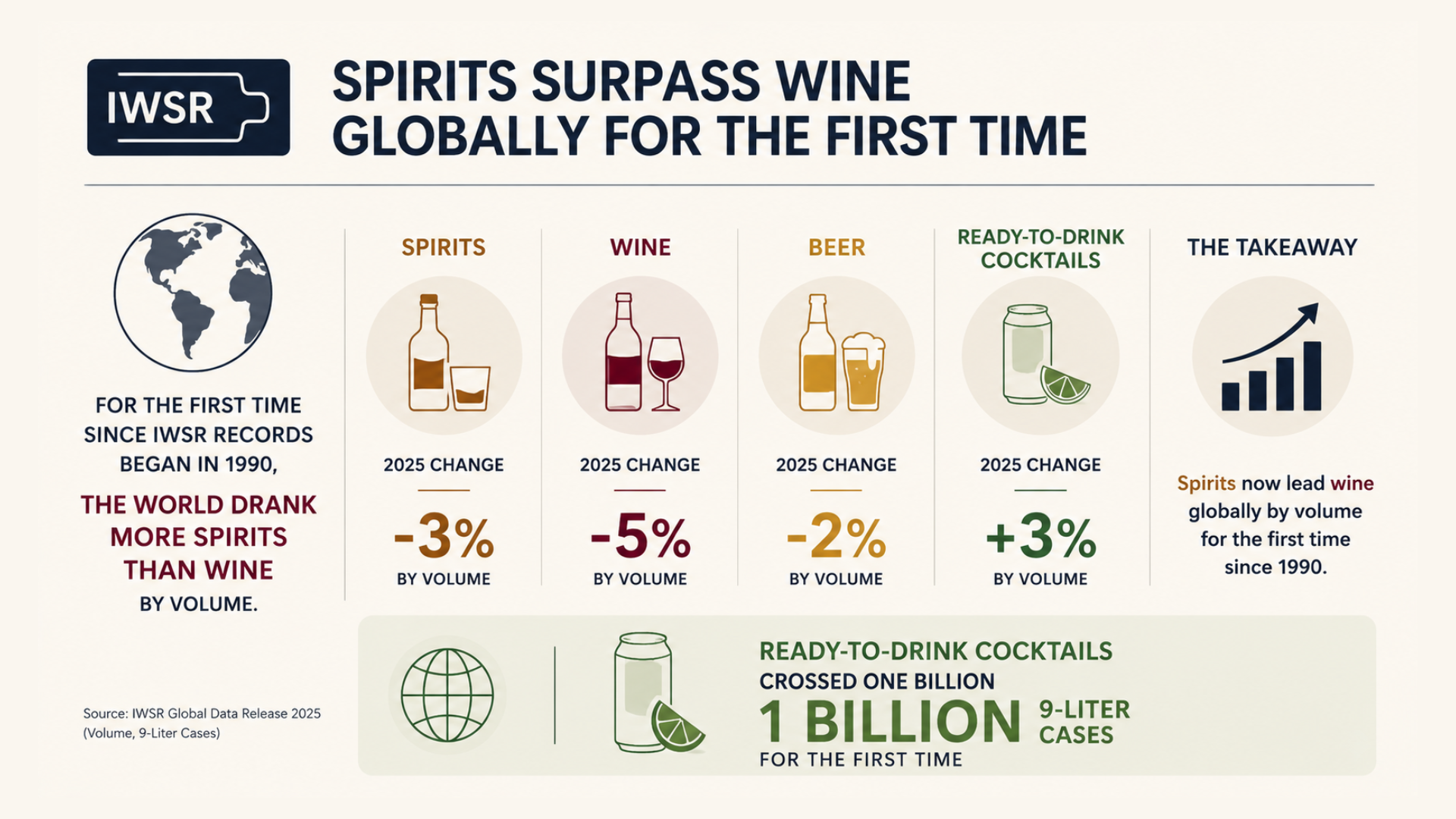 by volume. Both categories fell in 2025, but spirits slipped only 3 percent while wine dropped 5 percent, and that gap was enough to flip a ranking that has held for thirty-five years. Beer dipped 2 percent, while ready-to-drink cocktails grew 3 percent and crossed one billion nine-liter cases for the first time.
Other interesting Trends. From the article:
The number of alcohol servings consumed in China in 2035 is estimated to be 19% less than it was in 2025. Other nations forecast to report double-digit drops over the same period are the US (down by 18%), Japan (down by 15%), Germany (down by 14%) and the UK (down by 13%).
Bucking the trend are markets like Mexico (up 13%), Vietnam (up 15%), Colombia (up 26%) and India (up 38%), based on IWSR’s predictions for 2035.
When measuring consumption by servings, IWSR is betting on India to overtake the US as the world’s second-biggest market for alcohol, after China.
The past decade has seen China shift from volume-driven production to premium winemaking, as consumers look to trade up. As quality climbs, so does the wines’ global reputation. The third chapter of the Wynn Awards testified to a region on the up – celebrating diverse terroir, impassioned winemakers and, most importantly, what ends up in the glass.
“The level of sophistication, technical excellence and dedication among Chinese winemakers today is astonishing,” the competition’s chairman Eddie McDougall tells the drinks business. He largely attributes this to a generation of Chinese winemakers returning to the country armed with both international perspective and local knowledge of local terroir.
The Miertschins have created an inviting and relaxed atmosphere at Portree Cellars. Upon arrival, visitors are welcomed into the tasting room, where they can choose between indoor or outdoor seating. The outdoor area is particularly popular, offering scenic views of the rolling Texas hills that create a serene and calming backdrop to any wine tasting experience.
Unlike some wineries that require reservations, Portree Cellars is walk-in friendly, allowing guests to enjoy a casual yet refined tasting experience without the need to plan ahead. Whether you’re visiting for a spontaneous afternoon or a planned weekend getaway, the laid-back ambiance is perfect for unwinding.

The palate on this Tuscan wine is expansive, bold, and has a certain elegance to it, despite all of that lush dark fruit. Moderating green bell pepper compliments the richness of the luscious black cherry, black currant, and ripe plum, while earthy elements of olive and graphite add depth. Wisps of black pepper and cigar box offer secondary notes that fit perfectly with the profile of this full-bodied wine.

Dahl & Di Luca Ristorante is an Italian restaurant located in West Sedona, and once you step inside, you’d never know the Arizona desert is just outside the door. When you’re seated at your table, it’s like you’ve been transported to a romantic restaurant in a quaint Italian town. Inside the dimly lit dining room, you will see rustic exposed stone walls and a trio of sparkling crystal chandeliers that evoke a sophisticated, old-world feel. Crisp white tablecloths adorn each table, even those on the shaded patio overflowing with lush foliage.
Corkage Fee: $35 Per Bottle / Max 2
Las Vegas, NV
4.7 Stars with over 650+ Reviews
The Black Sheep is an acclaimed Vietnamese-American fusion restaurant in Las Vegas, owned by Top Chef finalist Jamie Tran. Located off-Strip in the southwest part of the city, it pairs traditional Vietnamese family recipes with classic French fine-dining techniques. It’s a popular spot for both date nights and adventurous foodies.