The Drinks Business
Sarah Neish reports for The Drinks Business that Opus One has unveiled a sweeping redesign of its Napa Valley estate following a five-year design process, with CEO Chris Lynch describing it as a “dramatic aesthetic change” aimed at redefining the property as a “thriving habitat.” The most immediate visual shift is the removal of the winery’s iconic manicured grass lawns and grass-covered roof, long a symbol of the estate’s polished luxury identity. In their place, landscape architect Reed Hilderbrand has installed over an acre of native, drought-tolerant, and pollinator-friendly plants chosen to mirror the rugged character of the surrounding Vaca Mountains.
From the article:
“This redesign serves a multitude of needs,” said Lynch. “Most importantly, it fulfills part of our 2030 mission to be globally responsible and will conserve up to 40% of the water previously used for irrigation.”
But luxury has taken on a different meaning in today’s water-poor climate.
“With water usage and conservation becoming a critical topic of consideration, we were obliged to reconsider the use of ‘lawns’ as an architectural element,” Lynch told db. “While graceful for decades, we could no longer avoid the conversation, and in 2021, the winery created a vision for change that led to the replacement of these pastoral berms.”
The Local France
Emma Pearson reports for The Local France that for the first time in recorded history, the French are drinking more beer than wine. Data released by the Organisation Internationale de la Vigne et du Vin shows that France consumed 22 million hectolitres of wine in 2025. According to the French brewery association Brasseurs de 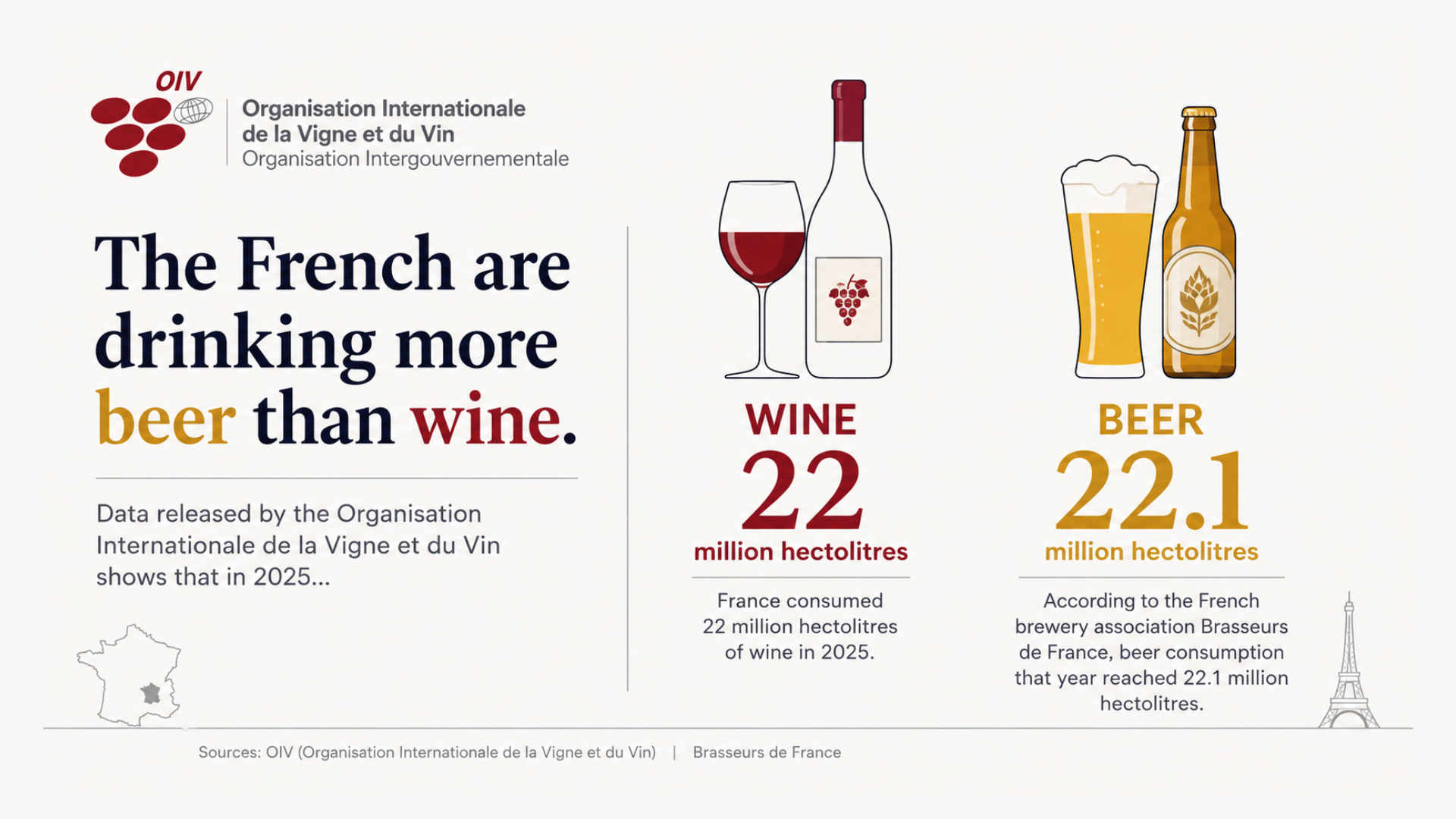 France, beer consumption that year reached 22.1 million hectolitres, a razor-thin margin but a genuinely historic crossing of the line. The shift has been building for years, driven by an explosion in craft breweries and microbreweries across France, particularly outside the traditional beer-drinking regions of the northeast. But the beer story is only half of it. From the article:
“For the first time in France’s recorded history, the country’s inhabitants are drinking more beer than wine.
Wine consumption in France has fallen by 37 percent within 30 years. In 1995, the French drank 37 million hectolitres of wine.
The explanation seems to be threefold: economic, health-related and cultural.
Wine Business
A press release issued by the Napa County Agricultural Commissioner’s Office and reported by Wine Business alerts that the glassy-winged sharpshooter, one of California’s most serious invasive agricultural pests, has been detected on grapevines sold at the Napa Costco Wholesale location between April 21 and May 26, 2026. The vines, totaling 220 plants, were shipped from Burchell Nursery in Fresno County. All life stages of the pest have been found on plants from these shipments across multiple California counties, and one egg mass was identified specifically in the Napa shipment. Of the 220 vines delivered, 157 remain unaccounted for and may already be in the ground or on the property of community members who purchased them this spring.
Bottom line here:
The stakes are significant. The glassy-winged sharpshooter is the primary vector for Pierce’s disease, a bacterial infection that is frequently fatal to grapevines and has no cure once established. It can also damage citrus, almond, and ornamental plants, making it a broad agricultural threat. Napa County officials are urging anyone who purchased a grapevine, citrus tree, or other fruit tree at the Napa Costco or a nearby location this spring to immediately isolate the plant, seal it in two secure trash bags, and contact the Napa County Agricultural Commissioner’s Office at 707-253-4357 for same-day inspection. Plants should not be returned, transported, composted, or planted. The Napa wine community has battled Pierce’s disease before, and early detection is considered the only effective tool for preventing a wider outbreak.
The Drinks Business
In a very long read over at The Drinks Business, Kathleen Willcox takes stock of a US wine industry six years into structural decline and asks whether the path forward runs through reinvention or retreat. The answer, she finds, depends entirely on who you are and whether you are willing to challenge assumptions about how, where, and why people drink wine. The doom headlines are real, but so are the pockets of growth, and the brands finding traction are the ones that stopped waiting for consumers to come to them.
Key Data Points
The Decline
US winery revenue fell to $74.3 billion in 2025, down $1.2 billion from 2024 and more than 20% below the industry’s $94 billion peak in 2020.
Overall US wine volume declined 4.2% year over year.
The US has lost nine million wine drinkers since 2023, dropping from 85 million to 76 million adults who drink wine at least occasionally.
Where Growth Is Happening
Non-alcoholic wine grew 18.7% year over year.
Organic and biodynamic wines rose from 28.4% to 29.9% of auction volume and from 35.6% to 36.2% of auction value on iDealwine in 2025.
Sparkling wine and white wine trade on Liv-ex has increased by 650% and 1,100%, respectively, since 2010.
Red wine activity on Liv-ex has dropped 15% since 2025 alone.
The Burgundy Shift
At US auction, Burgundy now represents 41% of value sold, up from 23% in 2019.
Bordeaux has dropped from 44% of value in 2019 to 29% in 2025.
Younger Consumers
Millennials represent 30% of revenue at fine wine retailer Benchmark Wine Group, drawn primarily to aged wines at peak maturity.
Younger consumers are drinking less overall but reaching for premium products when they do buy.
The Pricing Problem
- Compline in downtown Napa switched to retail-style markups and owner Matt Stamp reports selling more wine than ever, arguing that traditional three to four times wholesale pricing on prestige bottles is actively suppressing demand.


