
Sarah Brown, writing for Wine Business, reports that total winery direct-to-consumer shipment value fell nearly 10 percent in May to $246 million, with volume down nearly 23 percent to 375,249 cases. Over the 12 months ending in May, DTC value declined 5 percent, and volume fell more than 16 percent to 5 million cases. The average bottle price for the month hit $54.64, up 17 percent year over year and a new high for May, continuing a pattern in which average bottle price has climbed nearly 12 percent every month this year.
From the article:
Shipments of bottles with an average price of less than $50 continue to suffer double-digit declines in both value and volume, while shipments of wines with an average price of more than $150 grew 21% to $465 million and 11% by volume to 131 thousand cases. These gains erased only a fraction of the $139 million loss in total shipment value through May.
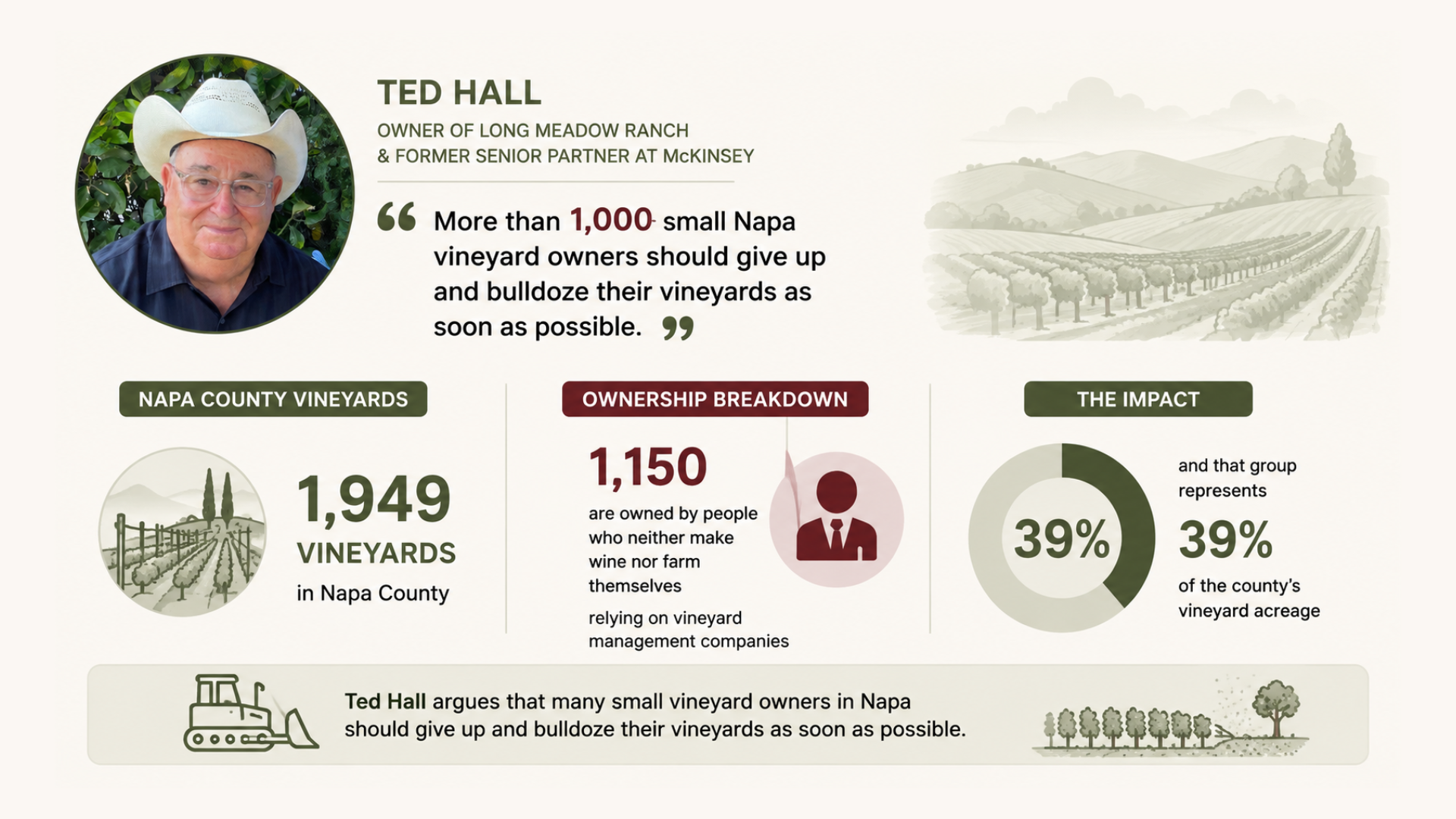 senior partner at McKinsey, and he has done the arithmetic. His argument is that more than 1,000 small Napa vineyard owners should give up and bulldoze their vineyards as soon as possible.
 From the article:
Small sites cost more to farm because they lack economies of scale. It costs nearly the same amount to bring a crew to prune or spray or pick five acres or 100 acres, yet that cost is spread over fewer acres and thus fewer grapes.
“Farming a 100-acre ranch runs about $13,400 an acre at current costs,” Hall writes. “A 10-acre block runs roughly $14,400. The smallest sites – one to three acres – cost over $18,000 on the valley floor and over $23,000 on a hillside.”
Those costs were affordable when Napa wines were selling out despite the average bottle price rising every year. But, since 2021, prices for uncontracted grapes and bulk wine have been dropping. If a small vineyard doesn’t have a contract with a winery, its grapes are currently not worth enough to pay the farming costs.
April Glover, writing for Nine.com.au, reports that Heartland Wines, a red wine producer based in Norwood in Adelaide’s east, has collapsed into voluntary administration owing roughly $3.6 million to creditors after nearly 30 years in operation.
The surrounding context is grim. Treasury Wine Estates posted a loss of almost $650 million in its February results. Wine Australia estimates more than 2 billion litres of wine sitting in storage, and Australian exports to all markets have fallen 33 percent.
From the article:
Australia also has an eye-watering oversupply of wine.
Wine Australia estimates there is more than 2 billion litres of stockpiled wine – the equivalent of almost 860 Olympic swimming pools – sitting in storage.
The Australian wine glut ballooned as growers grappled with Chinese trade sanctions.
The Asian powerhouse economy was the most valuable market for Australian wine exports in 2020, but then one year later China imposed anti-dumping tariffs as political and trade relations between Canberra and Beijing hit a low.
Arabella Mileham, writing for The Drinks Business, reports that the Italian Agriculture Ministry has signed off on the country’s first income stabilization fund built entirely for the wine sector. It works like a mutual: growers apply to become members, and if they suffer losses exceeding 20 percent of their average farm income, they can receive compensation covering up to 70 percent of that loss.
From the article:
The increasing instability that winemakers have been dealing with in recent years, from rising energy and technical costs, fluctuations in grape and wine prices, and the increasingly complex international dynamics.
Giovanni Menapace, president of Co.Di.Pr.A told Italian food and wine website Gambero Rosso that the tool “will represent a fundamental element for the resilience and stability of Trentino wineries”.
He previously called it a “paradigm shift in the economic protection of [wine] companies” which would complement other tools made already available including a mutual fund dedicated to plant diseases. Speaking when the fund was first announced in April, he noted that “the wine sector will have a new advanced tool at its disposal, capable of responding to systemic crises and not only to climatic events.
Oak Mountain is a Temecula winery on Via Verde with a genuine wine cave, and the tasting detail people remember is the wine tree: a vertical stand that holds your glass between pours. It sounds like a gimmick until you are three tastes in with nowhere to set a glass. Then it reads as the smartest furniture in Temecula.
The 2016 Lilian Ladouys is a Merlot-led Saint-Estèphe (62% Merlot, 32% Cabernet Sauvignon, 6% Petit Verdot) with a rigid but polished frame: grippy, fine-grained tannins around a core of black fruit, graphite, iron and dark chocolate. A streak of acidity keeps it moving, and the drying finish asks for substantial food.
Strip House does old-Hollywood steakhouse from the Planet Hollywood mezzanine: a sultry, vintage room, charred steaks, and sides built for sharing (truffle creamed spinach, goose fat potatoes). The bone-in ribeye is the order, and the 24-layer chocolate cake is not optional. Las Vegas has louder steakhouses; few cook this carefully.
Corkage Fee is $50 per Bottle/ Max 2
Bringing a bottle? The Cork & Journey app tracks corkage fees at thousands of restaurants. Check before you book.
Corkage Fee: $50 Per Bottle / Max 2
Las Vegas, NV
4.3 Stars with over 361+ Reviews
Orla in Las Vegas takes guests on a vibrant journey through the Mediterranean and Middle East, blending fresh, innovative twists on classic dishes with a passion for seafood. Inspired by the region’s rich flavors and traditional cooking techniques, Orla creates an elevated dining experience. Paired with warm hospitality and a lively atmosphere, it’s a celebration of Mediterranean zest and charm.