The Drinks Business
Sarah Neish, writing for The Drinks Business, reports that Pope Leo XIV has blessed the inaugural vintage from the two-hectare organic vineyard at Borgo Laudato Si, the 55-acre sustainable farming operation within the papal summer retreat at
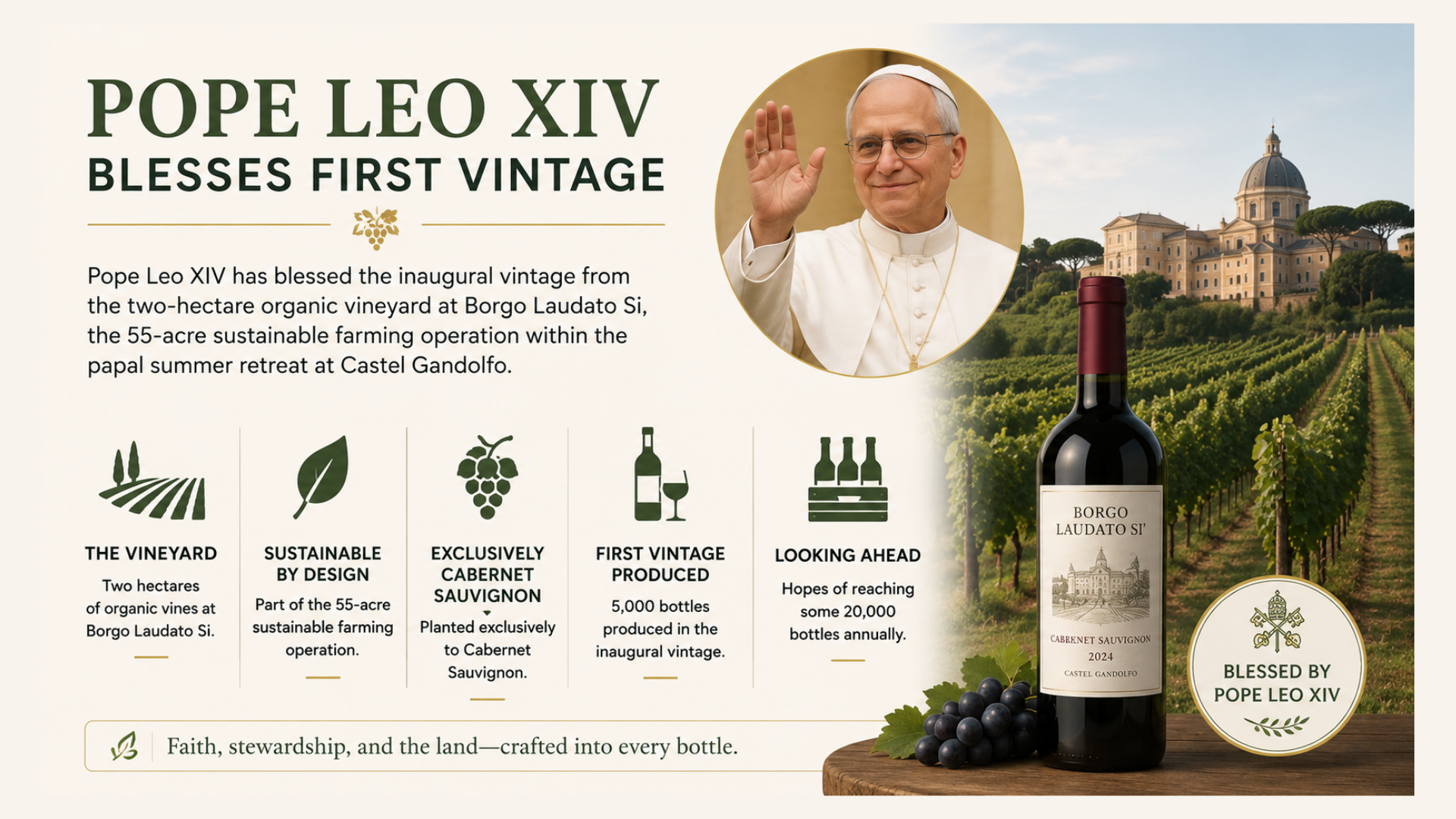 Castel Gandolfo. Planted exclusively to Cabernet Sauvignon, the vineyard produced 5,000 bottles in its first vintage, with hopes of eventually reaching some 20,000 bottles annually — though the Laudato Si office stresses production remains experimental.
From the article:
“Approximately 8,000 vines in the papal vineyard are tended and harvested by refugee workers as part of a programme that trains migrants and unaccompanied minors in the skills of sustainable agriculture, livestock care, and hospitality. Former prisoners are also welcomed into the winegrowing initiative, which aims to train more than 1,000 people per year. Once grapes are harvested, the 100% Cabernet Sauvignon wines are aged in oak barrels and thought to be sold within the Vatican.
Vatican City is a duty-free zone, meaning that bottles of wine are substantially cheaper to buy there than in the city of Rome. This has been the case since 1929, when the Lateran Treaty recognised the Vatican as an independent state. Within the Vatican, there are two shops selling wine; the Annona store, which is open to all, while the second is housed within an old railway station and only accessible by membership card holders.
Luxurious Magazine
The editorial team at Luxurious Magazine explores a discovery from the University of York, where scientists sequenced DNA from grape seeds preserved for two millennia in the oxygen-free mud at the bottom of wells in Chianti. The findings reveal that the region now synonymous with structured reds was historically anchored in white grapes.
From the article:
The most striking revelation is not the age of the vines, but their consistency, a single grape variety cultivated, maintained, and passed from Etruscan hands into Roman systems over centuries, suggesting a form of agricultural devotion that borders on philosophical.
Science too often privileges the visible line of proof, when in truth some of its most important advances have come from accident, improvisation, and the fortunate failure that only becomes meaningful when a curious mind is present to see it. The preservation of those seeds was accidental, the discovery itself accidental, and yet the result is a story of deliberate human care spanning centuries, a quiet demonstration that civilization often begins not with mastery, but with noticing, then reusing, then refining what was already there.
Wine Business
This press release from Texas Wine Growers (TWG), published via Wine Business, announces the strongest-ever showing by Texas wineries at the , and marking the largest Texas presence in DWWA history.
From the Press Release:
“This is a defining moment for the Texas wine industry,” said Bryan Chagoly, President of Texas Wine Growers and Co-Owner of Sandy Road Vineyards. “Winning Texas’ first Gold medals at the world’s largest wine competition, alongside this kind of depth across the board, shows that Texas isn’t an emerging wine region anymore – we’re an established one. Our winemakers are producing wines that hold their own against the best in the world.”
Random Call Outs:
93 PTS: Portree Cellars, Touriga Nacional, Texas High Plains, Texas, United States, 2022
94 points: La Valentía, Fire Oak Vineyard Grenache, Texas, United States, 2024
93 PTS: William Chris Vineyards, Cabernet Sauvignon, Texas High Plains, Texas, United States, 2023
Wine Spectator
Ron Geraci writing for Wine Spectator reports on a large Weill Cornell Medicine study of 26,694 Americans that found moderate drinkers showed no greater risk of dying from cancer over an average 13.3-year follow-up than peers who abstained. Lead author Dr. Laura Pinheiro, who had hypothesized she would find elevated cancer-death risk among moderate drinkers given the 2025 Surgeon General’s report, called the absence of a significant relationship surprising.
From the Article:
“When we set out to do the study, we had hypothesized that we would observe a greater risk of cancer death among moderate drinkers, given the different findings that have been recently presented in the Surgeon General’s [2025] report,” said lead author, Dr. Laura Pinheiro, associate professor of Health Services Research at Weill Cornell Medicine. “It was surprising that we didn’t observe a significant relationship between moderate alcohol consumption and cancer death.”
One of the study’s main objectives was to improve upon existing research on alcohol consumption and cancer risk that has informed recent recommendations from health organizations. These prior studies have reliability issues due to certain design features or their failure to sufficiently adjust for confounding factors that can skew results (such as differences among subjects in smoking, socioeconomic status and diet), according to the Weill Cornell researchers.


