
Jim Clarke, writing for Wine Review Online, makes the case that Cabernet Franc — not Riesling — may be emerging as New York State’s true signature variety. While the Finger Lakes has long owned the Riesling narrative, Clarke argues that Cab Franc is unique in its ability to cut across all three of New York’s major wine regions: the Finger Lakes, Hudson Valley, and Long Island.
From the article:
Cornell University studies have focused on finding the most appropriate clones of Cabernet Franc, determining which strains best handle New York’s conditions. Other Cornell programs have led to improved canopy management practices that better promote balanced ripening and help cope with Cabernet Franc’s susceptibility to fungal infections, which can be a problem in humid areas. Winery practices have become less forced; since the market has grown more receptive to fresher and lighter-bodied reds, less extracted wines – unburdened by excessive new oak – have become the norm.
For wine lovers who favor a more powerful, more Bordelaise take on Cab Franc, Long Island’s warmer, maritime setting comes closest to that profile, though big, blowsy examples are unusual from there. The wines typically show darker fruit and more body than their cousins from more westerly areas. As one moves north to the Hudson Valley and on to the Finger Lakes, the wines become lighter and more red-fruited, but leanness, greenness, and tight tannins are no longer common.
Eric Asimov, reporting from Bordeaux, France, for The New York Times, the region that practically defined fine wine, to tell a story of decline from the inside out. Once the toast of the world and still an icon of a roughly half-trillion-dollar global industry, Bordeaux now faces collapsing demand, a glut of unsold bottles, and a younger generation, at home and abroad, that simply drinks less. The piece captures the disorientation of growers watching a centuries-old birthright lose its grip on the very people who made it famous.
From the article: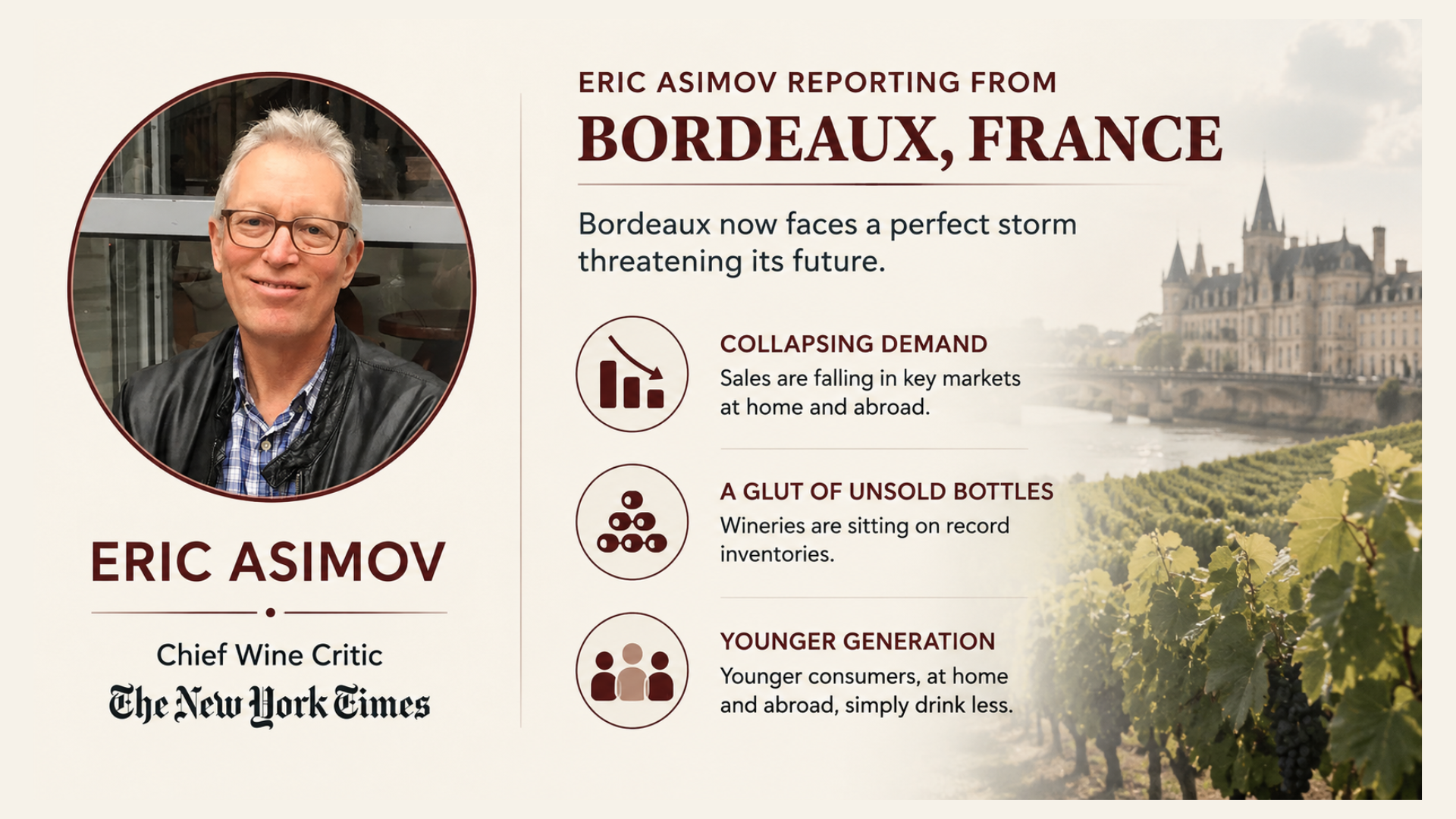
Nobody in Bordeaux is drinking Bordeaux.
On a recent visit to Bordeaux this spring, I saw patrons drinking Loire Valley wines. Burgundy, too, which a generation or two ago might have been considered sacrilege given the rivalry between the two great regions. More than any other, natural wines were everywhere. But Bordeaux? Barely a sign.
But in the city of Bordeaux’s more casual restaurants, where the clientele are not necessarily wine tourists, the absence of the region’s wines from the table, and many of the lists, is glaring.
“This is a big subject of discussion in the city,” said Jane Anson, a wine critic and author of “Inside Bordeaux,” who lives here.
Last year, Pierre Hurmic, then Bordeaux’s mayor, asked the city’s restaurants to start serving more Bordeaux.
Emily Saladino reports for Wine Enthusiast on a quiet identity war playing out on Australian wine labels. For decades, big, bold, high-alcohol Shiraz was the country’s identity, and a multimillion-dollar global brand. But as drinkers worldwide drift toward lighter, fresher reds, a wave of leaner, “crunchier” expressions has emerged, and a growing number of producers are relabeling their wines “Syrah” to signal a more restrained, Rhône-inspired approach.
From the article:
When big, boozy reds occupied most of the thrones in the wine world’s royal court, Australian Shiraz wore a purple-teethed crown. Heavily oaked, high-alcohol iterations were beloved far and wide, making Aussie Shiraz a global brand with a $51 million U.S. market.
But every reign has its detractors—and defectors. In recent years, wine drinkers worldwide started to favor lighter, lower-alcohol wines. Winemaking evolved, too, and a wave of leaner, crunchier Shiraz expressions emerged across Australia. Some of these Aussie producers ditched their homegrown nomenclature and dubbed their wines “Syrah” to denote their Rhône-style approach.
Tibi Puiu, reporting for ZME Science, recounts one of the strangest wine discoveries on record: a reddish liquid sealed inside a 2,000-year-old Roman funerary urn in Carmona, southern Spain, that turned out to be the oldest wine ever found in liquid form. Unearthed when a family stumbled on an intact Roman mausoleum in 2019, the urn held the cremated remains of a man, a gold ring, and roughly five liters of what was originally a white wine, darkened over two millennia by time and the contents of the tomb.
From the article:
Although molecular traces of ancient wines have been found staining pottery walls, this is the oldest wine in a liquid state identified thus far, claim archaeologists at the University of Cordoba. Previously, the earliest surviving wine was from fourth-century AD wine bottles found in Speyer, Germany in 1867.
The tomb had remained completely sealed since the remains were placed inside. This ultimately preserved the liquid wine, ruling out other causes for the presence of the liquid, such as floods, leaks, or condensation.
Bingham Family Vineyards in Grapevine, TX
Today, Bingham Family Vineyards farms over 200 acres of grapes and supplies over 20 Texas wineries with a diverse range of wine grapes. With this kind of grape access, the brand can craft wines that are made with 100% Texas grown grapes.
Just 10 years after those first vines were planted, the brand began winning awards in national and international wine competitions, helping put Texas wine on the map! Winemaker Sam Jennings was appointed the brand’s head winemaker in 2021.
Catena Zapata Malbec Argentino 2019

In the glass, the 2019 Catena Zapata Malbec Argentino is a deep garnet color. The nose evokes dark ripe fruits, most notably black cherry, and blackberry, as well as concentrated raisin, coffee, and leather notes.
Picking this wine out as a Malbec from Argentina would be effortless in a blind tasting; the palate is classic Malbec. Like the nose, the palate sings with black cherry, blackberry, and plum. Pleasant spices like black pepper, coffee, and sweet tobacco put on a showy display and are followed by a long finish. This Catena Zapata wine is full-bodied, well-balanced, and a lovely example of why the world looks to Argentina when it wants a satisfying bottle of Malbec.
El Gaucho Argentino Restaurant in Playas de Rosarito, MX

This wildly popular Rosarito restaurant started out as a beach-side food stand whose specialty was lomito, an Argentinian steak sandwich made from thinly sliced filet mignon served on a fresh bread roll and topped with items like chimichurri, cheese, and tomatoes. El Gaucho Argentino built such a strong reputation on hospitable service and delicious Argentinian street food that they opened a brick-and-mortar space on the main drag of Rosarito not long after the food stand took off. The restaurant has since moved a short distance away but maintains the loyal customer base that made El Gaucho Argentino one of the best restaurants in Rosarito.
Corkage Fee: $20 Per Bottle / Max 2
Los Angeles, CA
4.1 Stars with over 290+ reviews
Mi Corazon offers the freshest, cleanest neo-traditional Mexican cuisine in a modern mexi-goth atmosphere. Non-GMO, Organic proteins and vegetarian/vegan options are the foundation of our menu with House-made everything!