Press Democrat
This Press Democrat story by Jeff Quackenbush, about Constellation Brands, the owner of the above-mentioned Robert Mondavi Winery, signals that the premium wine category is still facing a slower-growth environment. The key quote comes from Constellation’s finance chief, who says the company has seen “tasting room softness” at its Napa-based wineries, even though fourth-quarter results showed some improvement.
Premium wine is not collapsing, but it is no longer enjoying the easy growth that defined earlier years.
From the article:
 Visitation to Napa County tasting rooms was up 3% overall in 2024 from the year before but was down by just over 3% for the first quarter of 2025, according to the latest data from Wine Business Monthly and Community Benchmark. But Oakville and Rutherford had nearly 6% annual growth in visitors, while downtown Napa visits were nearly even.
The New York-based company said its portfolio is increasingly focused on higher-priced wine brands such as Mondavi, Schrader Cellars and The Prisoner Wine Co., following the divestiture last year of lower-priced labels…
Constellation reported $9.14 billion in net sales last year, down 10% overall and 4% for brands remaining in the portfolio. The wine and spirits segment made up just 9% after the wine and Svedka vodka brand and asset sales, resulting in cases shipped down 62% year over year and the dollar value of net sales off by 51%. But considering just the remaining brands, shipments were down nearly 7% for the year, depletions of wholesaler inventory by 4.3% and net sales down 14%.
SF Chronicle
In this San Francisco Chronicle story, wine reporter Jess Lander covers the reopening of Robert Mondavi Winery after a three-year closure and a major renovation. The Oakville property reopened on April 20th with a dramatic redesign that restores its iconic arch and tower while adding new tasting spaces, culinary experiences, outdoor cabanas, a wine library, and modernized winemaking facilities.
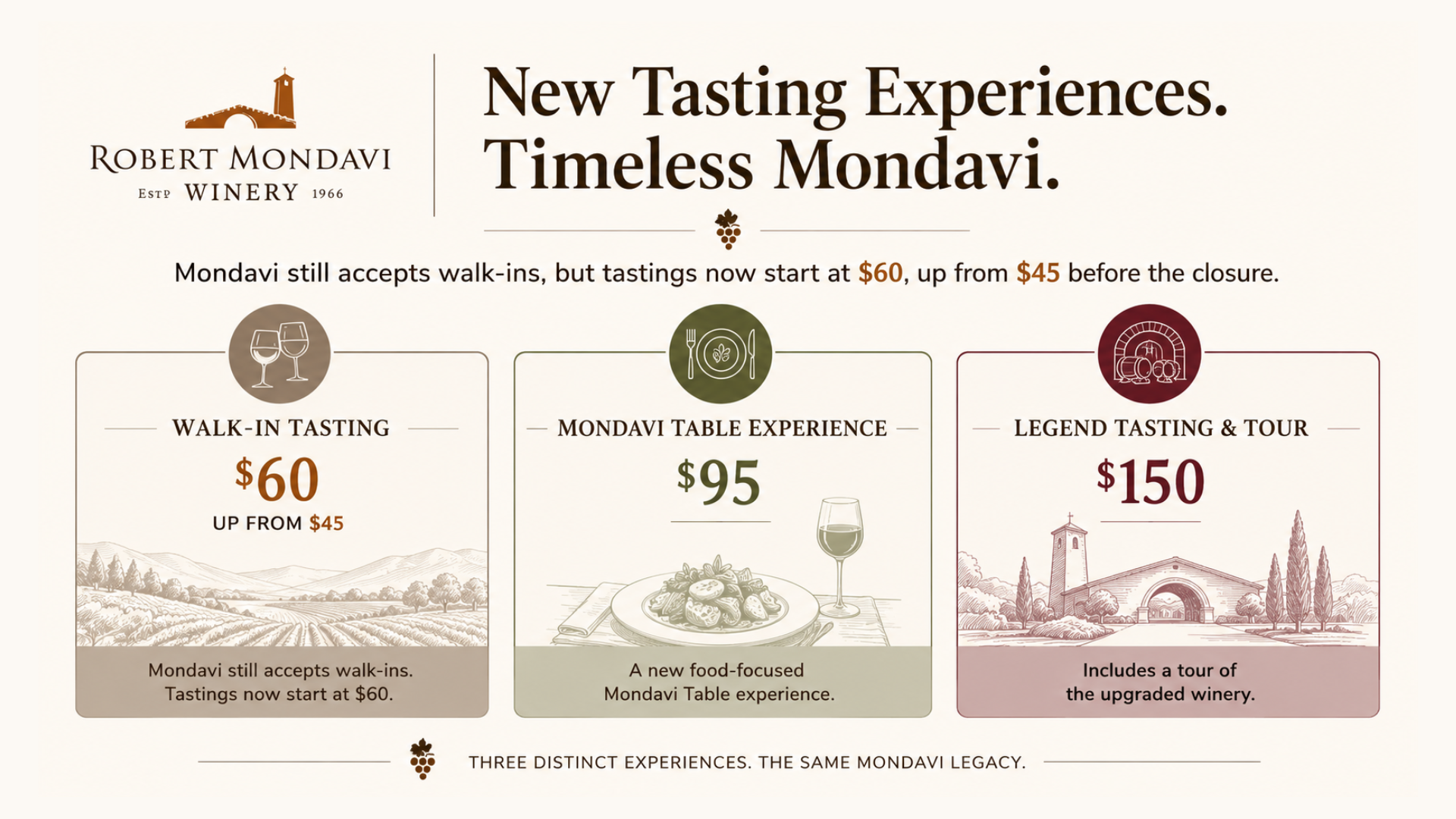
Mondavi still accepts walk-ins, but tastings now start at $60, up from $45 before the closure. The new food-focused Mondavi Table experience is $95, while the Legend Tasting and Tour, which includes a tour of the upgraded winery, is $150. That makes the reopened Mondavi more upscale than before, but still somewhat below the top end of Napa’s current tasting-room pricing
From the article:
The winery, which felt increasingly old-fashioned, now appears as a sprawling, glass-walled tech campus seemingly uprooted from Silicon Valley and dropped in the middle of a vineyard. No part of the estate was left untouched — even the iconic arch and tower were painstakingly restored — while several new buildings and outdoor spaces were constructed, making it appear double the original size. Unlike before, Mondavi’s famed To Kalon vineyard is the focal point of the property, viewable from nearly every vantage point, while the design pays homage to the winery’s six decades of history without getting hokey. If Robert Mondavi, a marketing mastermind who died in 2008, were here today, it’s easy to imagine that his vision for the next era of Mondavi might look something like this: majestic, vast, and the first of its kind.
Vino Joy News
Writing for Vino Joy News, Morris Cai reports that
The numbers tell a story of a brand struggling to stay relevant in a shifting market. Changyu had already cut its 2025 revenue target from RMB 4.7 billion to RMB 3.4 billion, yet still missed it. Wine, which accounts for over 70% of the company’s revenue, fell by 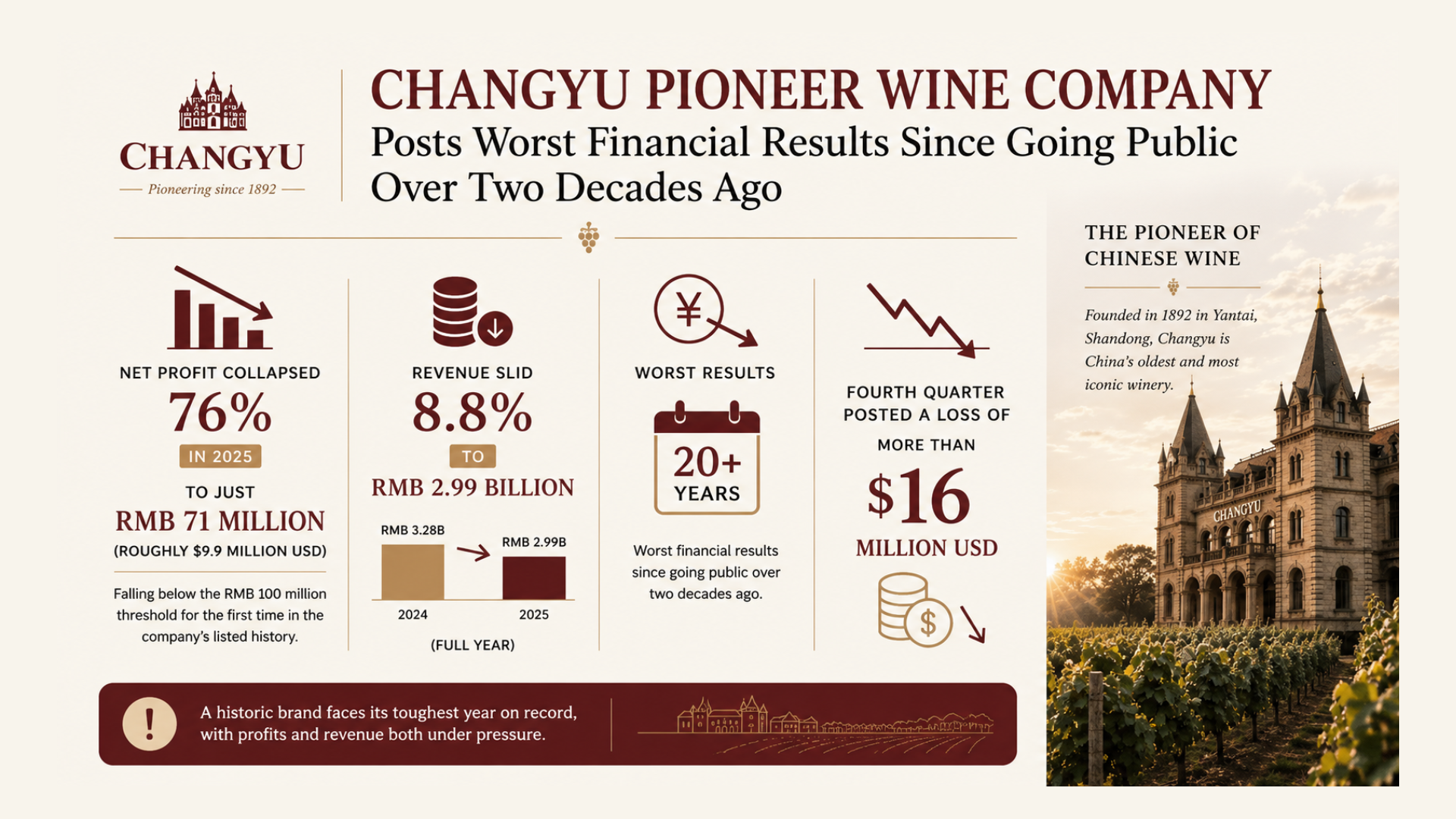 more than 12%, while brandy provided only a partial offset. Flagship mid-range products like Noble Dragon are losing ground in wedding banquet channels, and the premium-label Longyu Estate faces an uphill battle for brand recognition against entrenched names like Penfolds and DBR Lafite in high-end dining settings. In response, Changyu has been reaching for younger consumers with new product lines.
From the article:
The company has attempted to reposition itself in recent years. In 2025, it launched a new white wine brand, “Long Tailed Cat”, targeting younger consumers and new retail channels.
At the 2026 China Food and Drinks Fair in Chengdu, Changyu further introduced canned wines and ready-to-drink products, and signed actor Yu Shi as a brand ambassador, in a bid to strengthen its appeal among younger consumers.
Vino Joy News
Natalie Wang reports for Vino Joy News from a panel discussion organized by the publication at Vinexpo Hong Kong, where three of China’s most influential wine retail and digital media figures shared data challenging some of the wine industry’s most deeply held assumptions about the Chinese consumer. While markets in the United States and Europe are grappling with declining wine consumption among younger generations, the picture in China looks strikingly different. According to the panelists, the majority of wine consumers on China’s leading retail and social platforms are now under 35, and the category is increasingly driven by women.
The panelists included Xiao Pi, a wine KOL with over 750,000 followers who operates one of the top-performing wine shops on Tmall; Annie Wang, CEO of SommCat and co-founder of WineTopia; and Thomas Yang, Private Brand Purchasing Manager at Waima, the fast-growing alcohol delivery platform owned by Meituan. Together, they painted a portrait of a consumer base that discovers wine through smartphones, short videos, and livestreams rather than critics or formal education, and buys based on mood, lifestyle identity, and emotional resonance rather than regional classifications or technical credentials. The takeaway for the global wine industry is significant: the next generation of wine drinkers may not be lost. They may simply be in China.
From the article:
“We have nearly two million people visiting our shop every year, and about 45% are female drinkers and buyers,” says Xiao Pi, one of the earliest wine KOLs in China with over 750,000 followers across Chinese social platforms, and operates one of the best-selling wine shops on Tmall.
The age profile is changing just as quickly. “50 percent of our drinkers were above 40 years old 5 years ago. But yesterday I checked, 70% of them are below 40,” he shared, adding that round 20% are between 25 and 35 years old, while another 12% are under 25.


