
Press Release – Breakthrough with First Successful Harvest of Disease-resistant Grapes Shows Hope for a Florida Wine Renaissance
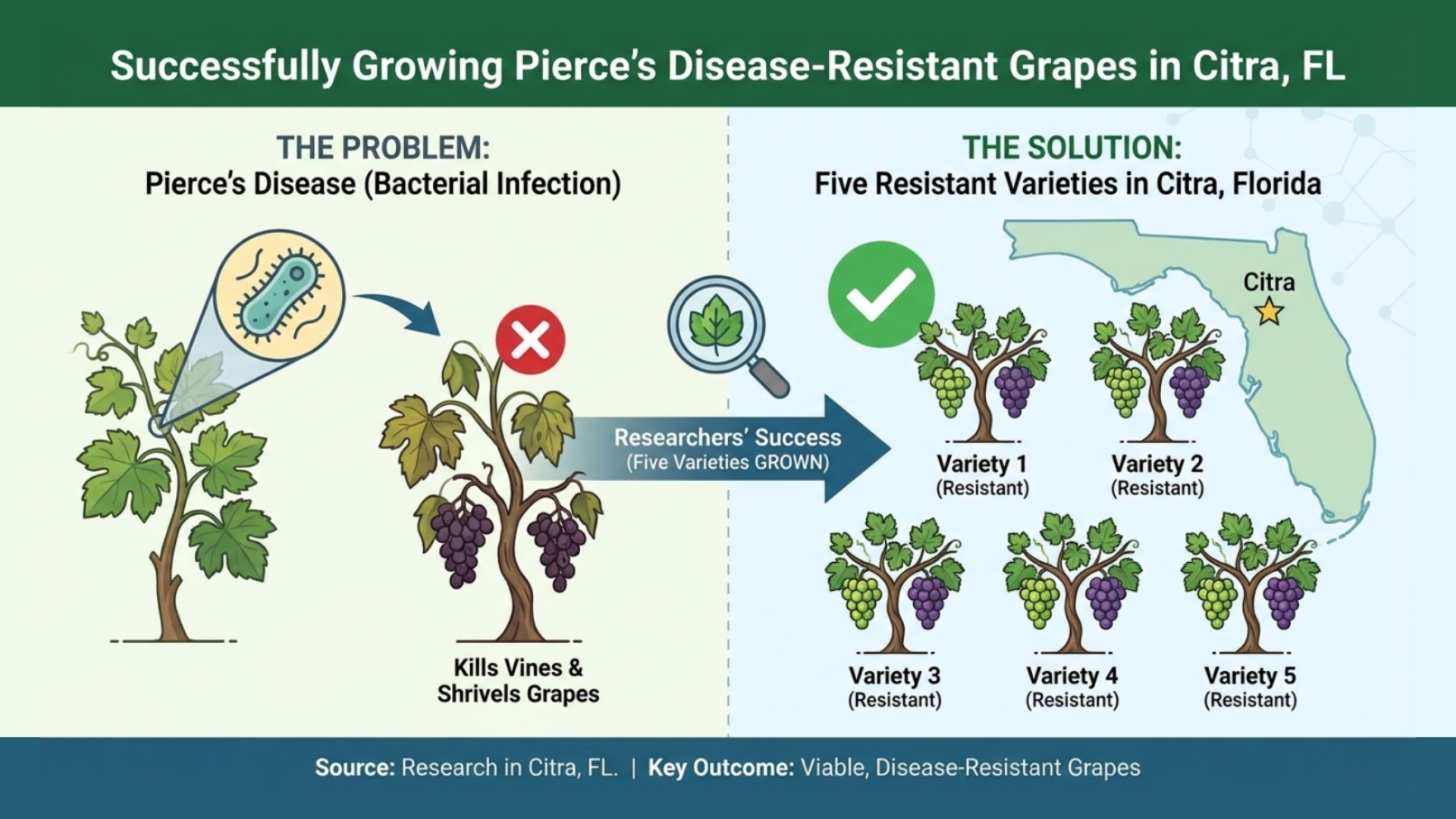 In Wine Business, the article “Breakthrough with First Successful Harvest of Disease-Resistant Grapes in Florida” reports that researchers in Florida have successfully grown five grape varieties resistant to Pierce’s disease — a bacterial infection notorious for devastating vineyards. This breakthrough could expand grape-growing into previously untenable regions and offer new hope for growers battling disease pressures. From the Article:
While Florida has a thriving muscadine grape industry, the global market for muscadine wine is small compared to wine made from Vitis vinifera, the species of grapes behind world-famous wines such as cabernet sauvignon, sauvignon blanc and merlot. Florida is already the nation’s second-highest wine-consuming state, behind only California, with an industry valued at $15 billion in 2022. Yet most of the wines served are produced elsewhere, primarily in California, Oregon and Washington.
Sarkhosh said he hopes this research will offer a potential additional crop for muscadine grape farmers. As of 2017, there were 547 Florida vineyards, growing muscadine and hybrid grapes.
Reuters – France To Help Wine Industry With $150 Million In Aid For Vines Uprooting
Reuters is reporting that the French Agriculture Ministry has confirmed that France will spend €130 million (about $150 million) on a new vine-uprooting plan to help its crisis-hit wine sector by permanently pulling up tens of thousands of hectares of vines. This is effectively “phase two” of a structural reset: in 2024, France already earmarked €120 million to fund the permanent removal of up to 27,500 hectares of vineyards to tackle oversupply, especially in struggling red-wine regions like Bordeaux. Together with more than €400 million spent on crisis distillation and surplus destruction since Covid, the new package underscores just how aggressively France is now shrinking its vineyard footprint to rebalance supply in the face of falling consumption, climate shocks, and tariff pressure. From the Article:
The French Agriculture Ministry said on Monday it would give the wine industry additional support of 130 million euros ($149.80 million) for the further uprooting of vines, to guard against excessive output, adding it would also ask the European Union to chip in.
“The sector is suffering from a deteriorating situation, marked by the effects of climate change, which have repeatedly affected harvests for several years, the continuing decline in wine consumption – particularly red wines – and major geopolitical tensions,” the ministry said in a statement.
The Drinks Business – Vinarchy To Axe 60 Wine Brands As It Targets Younger Drinkers
In The Drinks Business, Ron Emler reports that Australia’s second-largest wine company, Vinarchy, is preparing a sweeping overhaul: cutting about 60 wine brands — roughly 40% of its portfolio, shifting toward smaller formats, lower-alcohol styles, and new packaging, all aimed at attracting a new 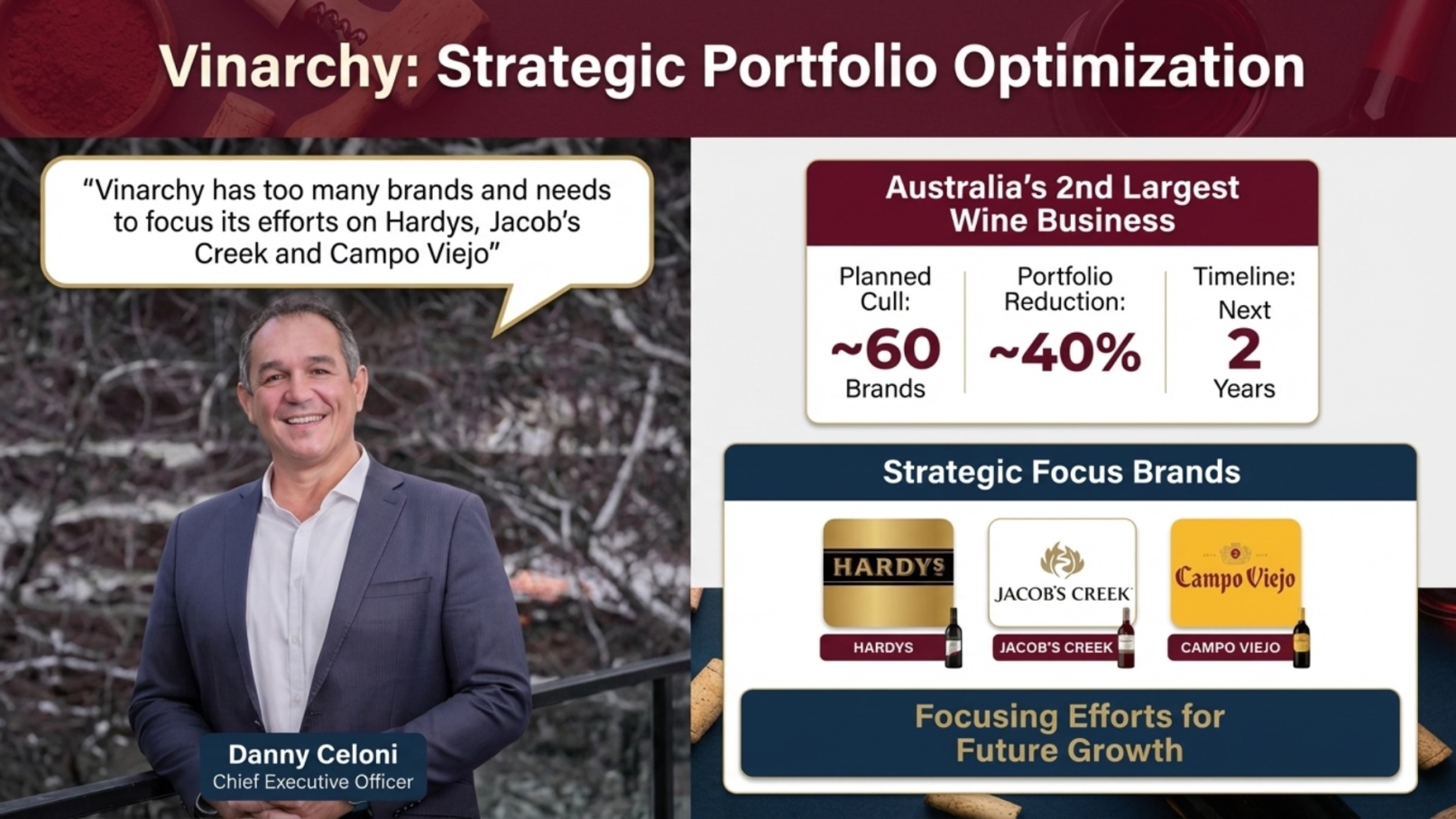 generation of drinkers. Under new CEO Danny Celoni, the company is consolidating operations, prioritizing global power brands like Hardys, Jacob’s Creek, and Campo Viejo, and investing AU$30 million in Barossa to reshape its production footprint. From the article:
A Strategic Pivot Towards Younger Drinkers
In addition, Vinarchy is planning a serious drive to tap into a new generation of drinkers by shifting to smaller bottles to appeal to customers who are more selective and drinking less.
This programme will include the launch of mini bottles, a chill-infused rosé and a mid-strength Sauvignon Blanc, further breaking away from the characterisation of Australian wines as high in alcohol.
James Suckling – Bursting Out in All Directions: Texas 2025 Tasting Report
Over at JamesSuckling.com, the 2025 Texas Tasting Report shows a region “bursting out in all directions,” with Texas wine quality accelerating under stricter new rules that require more Texas-grown fruit and a more apparent regional identity. What stands out is how closely the results align with our own coverage on Cork & Journey: Calais Winery, already the star of our review of French-born winemaker Benjamin Calais, again earned Suckling’s highest score of the entire report, confirming what we’ve been saying — Calais is producing some of the most compelling wines in the state. Likewise, Ron Yates, a winery we spotlighted for its terroir-driven Hill Country reds, also appears in the report with strong showings that underscore a maturing, increasingly ambitious Texas wine scene. With 239 wines tasted across the Hill Country and High Plains, the report reinforces what C&J readers already know: Texas is no longer an emerging region — it’s breaking out. From the report:
We arrived to conduct our second major tasting of Texas wines in less than a year, finding a broader range of high-scoring wines than before and the same fascinating diversity in grape varieties and growing regions.
What stood out this time was our exposure to numerous high-quality wine producers that were new to us, as well as the huge span of wine styles and types. Our highest scoring wines include a roussanne (white Rhone grape variety) from the Texas High Plains appellation, chardonnay and tempranillo from the Texas Hill Country and a large number of red blends with the broad “Texas” designation on their labels.
Weisinger Family Winery (Ashland, Rogue Valley AVA)
Ashland’s original craft winery, Weisinger Family Winery pairs small-lot, locally sourced wines with relaxed, view-forward hospitality. With a seven-wine flight for $12 and a genuinely welcoming setting, it’s one of the easiest recommendations in Southern Oregon.
2022 Rutherford Hill Merlot (Napa Valley)

Rutherford Hill—among Napa’s Merlot pioneers—delivers a plush, full-bodied 2022 that marries ripe black-fruit intensity with polished oak and a long, savory finish. It’s approachable now yet structured enough for short-term cellaring, offering strong value at the winery’s $38 release price.
Hostaria Baccofurore – Furore, Italy

Perched high above the Amalfi Coast, Hostaria Baccofurore (often called Hostaria Bacco) blends regional Campanian cuisine, cliffside views, and a family tradition that has defined local hospitality since 1930.