
The Drinks Business – Rift Grows in Regenerative Viticulture Movement?
In The Drinks Business, Andrew Neather reports that the regenerative viticulture movement is experiencing growing internal friction over how it should define itself and scale globally. The article outlines a widening debate between those who want regenerative viticulture formally aligned with existing certification frameworks, such as organic standards, and those who argue that doing so risks narrowing its reach and slowing adoption.
For wine producers already navigating organic, biodynamic, and sustainability certifications, the debate signals another potential layer of compliance complexity and another marketing term that requires clarity for consumers. From the Article:
Leading viticulture authority Jamie Goode has slammed the insistence of some regenerative bodies on growers also being organic. Speaking this week in Roussillon at a forum hosted by regenerative winemaker Domaine Lafage, Goode said, “If we tie regenerative viticulture to organics, it’s finished… It will be a small, fancy club for people to feel good about themselves. It’s bullshit. The ROC [Regenerative Organic Certification] approach is nonsense.”
Regenerative viticulture has attracted huge interest over recent years, especially in California. It focuses on improving soil health and the soil’s level of organic matter, using methods including cover crops, mulching, integrating of grazing animals in the vineyards, and not tilling the soil.
The Drinks Business – Why Stanislas Thiénot is confident in the future for Champagne and Bordeaux
In an interview with The Drinks Business, Patrick Schmitt explores why Stanislas Thiénot, head of the ARVITIS – Thiénot Family & Estates group, remains upbeat about the future of both Champagne and Bordeaux despite global market headwinds. He emphasises that diversification, international growth, and a focus on quality continue to underpin resilience even as challenges such as rising production costs and geopolitical pressures persist. The piece highlights that while mainstream wine sectors face pressure, premium sparkling wine and classic French regions retain strong appeal for global consumers. From the Article:
Finally, he sees an end to the oversupply situation that has plagued Bordeaux in recent years, following a sharp reduction in production caused by large-scale vineyard removals.
“We are now producing less than we have been selling over the past two years, and although we are at a low point in terms of sales, we are still selling more than we produce – and that’s because the Bordeaux vineyard area has moved from 120,000 hectares before Covid to 80,000 hectares today,” he said.
Indeed, he sees Bordeaux facing a “natural shortage” of wine in the near future, when the region’s “overstock has been absorbed.”
Finally, he stated, further expressing his optimism for the region: “Bordeaux has centuries of history – you cannot erase that in just a few years.”
UPI – Argentina’s Wine Industry Faces Deepest Crisis in Two Decades
In United Press International, Banyeliz Muñoz reports that Argentina’s wine sector is enduring its most severe crisis in roughly 20 years, as falling exports, collapsing domestic consumption, and sustained economic instability converge to pressure producers across the country. From the Article:
Iconic producers such as Norton and Bianchi have begun debt renegotiations or turned to legal mechanisms to avoid bankruptcy after accumulating large unpaid obligations. The financial 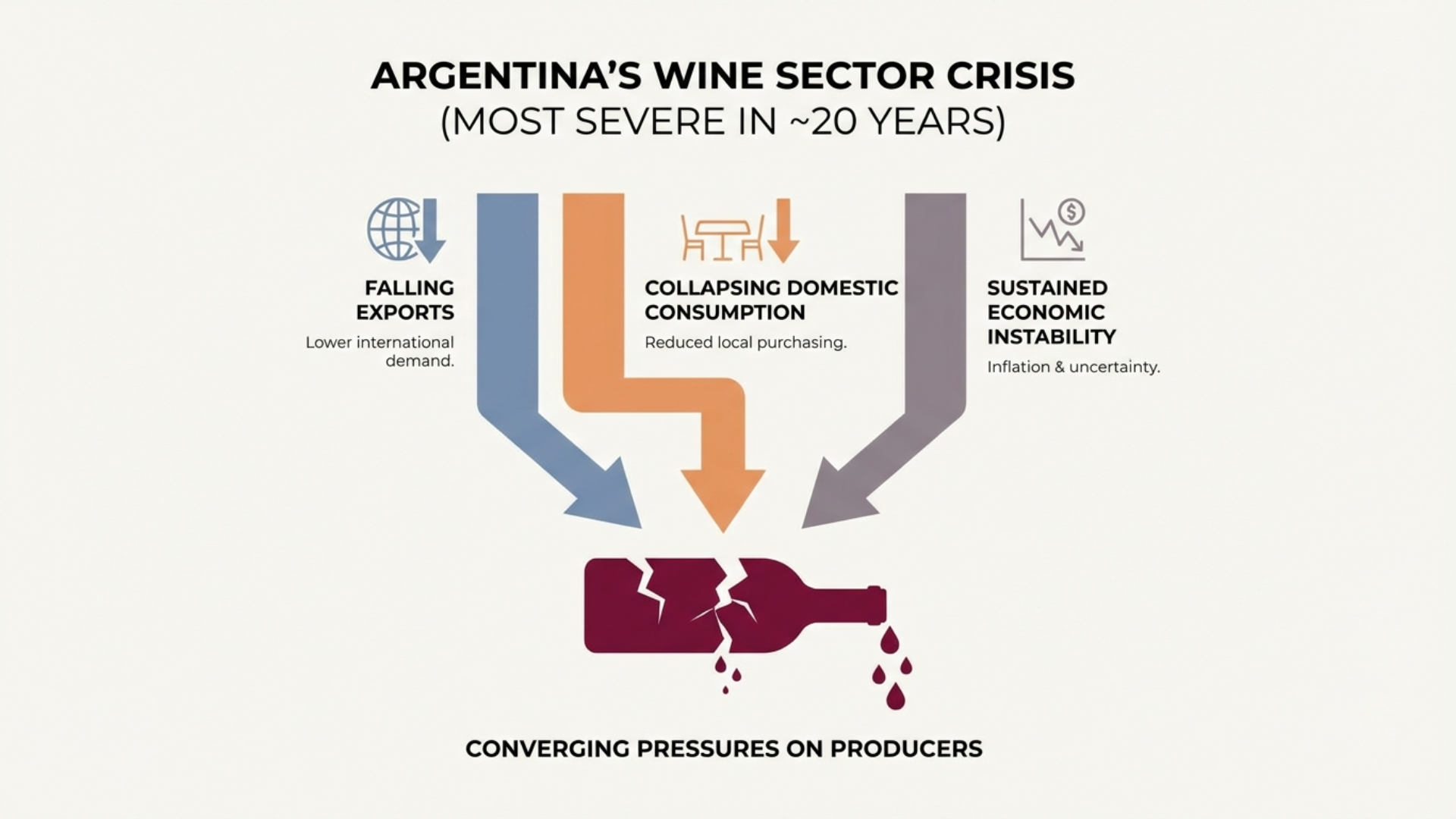 deterioration points to structural problems that affect much of the wine value chain.
Rising competition has compounded the problem. Over the past 15 years, wine supply has grown far faster than demand. Gimenez noted that a U.S. supermarket can offer wines from about 2,000 different wineries, with more than 5,000 labels.
At home, the domestic market has also deteriorated sharply. Wine consumption fell 12.5% in November 2025, according to data from Argentina’s National Institute of Viticulture.
Economist Elena Alonso, co-founder of consulting firm Emerald Capital, told UPI that falling wine consumption largely reflects macroeconomic pressures. She cited high inflation, declining purchasing power and years of stagnating real incomes.
Wine Business – Historic DNA discovery: Turkish Kolorko identified as Hungary’s Furmint
Wine Business reports a significant ampelographic discovery in the world of viticulture: the Turkish grape variety Kolorko has been identified through genetic analysis as identical to Hungary’s iconic white wine grape, Furmint. This revelation deepens the historical and genetic connections between grape varieties across Europe and the Middle East, offering new insight into the spread and evolution of vines over centuries. Furmint is best known for its role in Hungary’s famed Tokaji wines, prized for their complexity and aging potential. The finding may impact how grape biodiversity and heritage are understood in both regions, and could influence future research, conservation efforts, and marketing narratives around these varieties. From the Press Release:
…the most plausible historical explanation for this shared identity dates back to the early 18th century. After his defeat in 1708 against the Habsburgs, Prince Francis II Ra´ko´czi, leader of the Hungarian independence movement, lived in exile in Poland, France and finally in the Ottoman Empire where he settled in Tekirdag (then Rodosto), accompanied by many Hungarian nobles. Although no written record confirms the transport of vine cuttings, this historical context provides a compelling framework for the introduction of Furmint into Ottoman Thrace.
Dragonette Cellars: Precision and Patience in Santa Barbara
Dragonette Cellars produces small-lot wines from Santa Barbara County’s cool-climate vineyards, with a focus on Pinot Noir, Sauvignon Blanc, and Syrah. Founded in 2005 by brothers John and Steve Dragonette alongside Brandon Sparks-Gillis, the winery emphasizes vineyard management and minimalist cellar practices to express site-specific character and balanced structure.
2020 Vigorello Rosso Toscana IGT

San Felice’s 2020 Vigorello is a Toscana IGT blend led by Pugnitello, with Merlot, Cabernet Sauvignon, and a splash of Petit Verdot. Aged 24 months in French barriques, it shows dark berry fruit, sweet spice, and tobacco, framed by firm tannins and fresh acidity. Built for cellar, approachable after decanting.
Classic Steakhouse Fare and Ocean Views at 21 Oceanfront

Perched right at the Newport Pier, 21 Oceanfront focuses on the kind of dining that never goes out of style: traditional steak and seafood. Chef Jesus Mendoza leads a kitchen that prioritizes great ingredients, think perfectly cooked filet mignon and fresh salmon, over complex trends. With an atmosphere that feels like old-school luxury, it’s a reliable spot for a structured dinner by the water.