
Meiningers International – Is the Worst Almost Over?
Jeff Siegel summarizes insights from the 2026 Silicon Valley Bank Wine Industry Report, discussed on Meininger’s International, about the current state and future trajectory of the U.S. wine market. — the report anticipates the industry may hit a “bumpy” bottom in 2027–2028 before
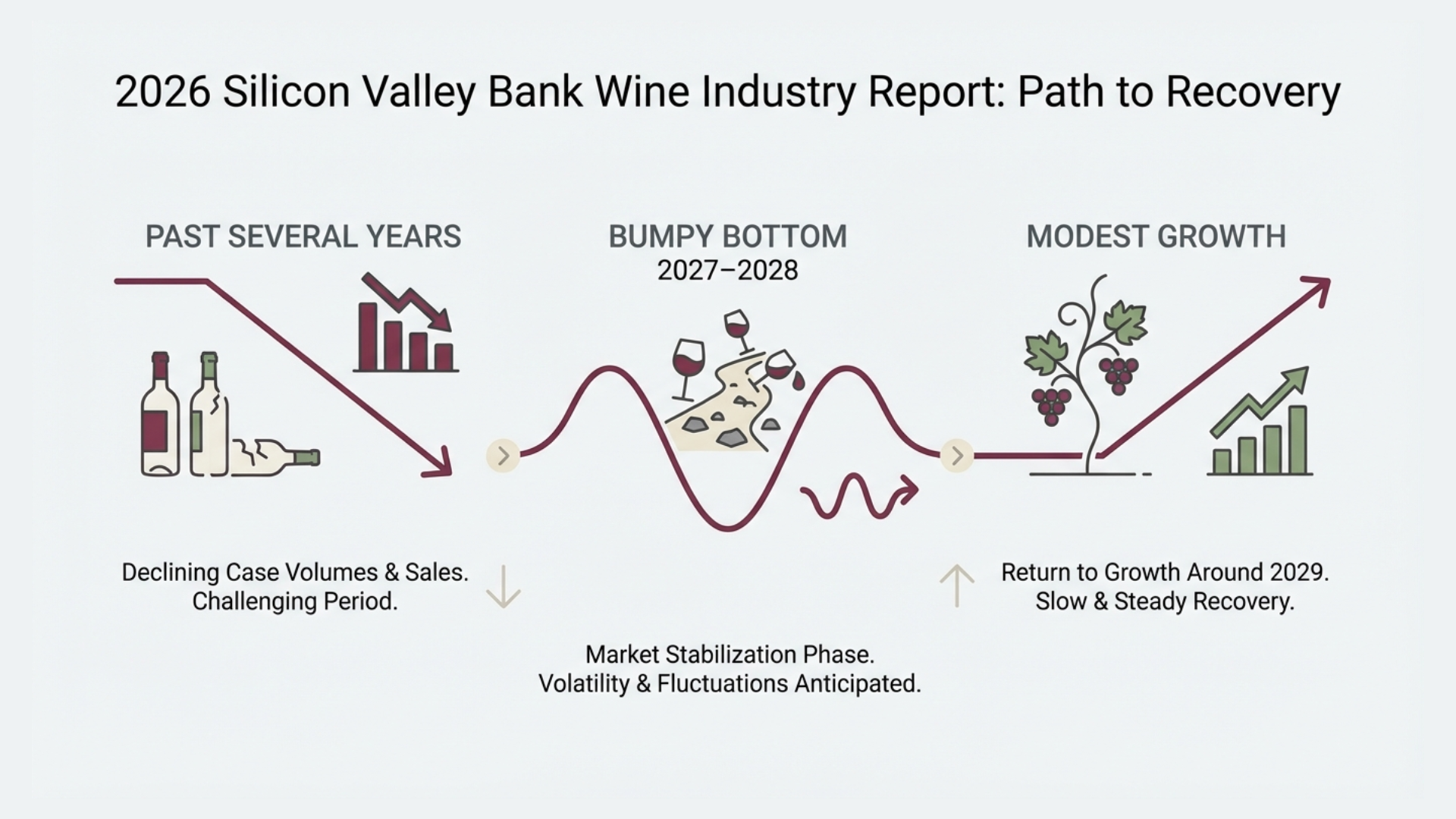
modest growth returns around 2029, driven in part by shifting consumption among younger adults and a leaner industry structure. From the article:
One thing that McMillan expected in 2025 that didn’t happen the way he thought was discounting. Yes, there was discounting, but it took place with private label and not necessarily with price cuts on typical brands at retail.
“While there are no good sources of accurate private-label sales data, based on company reports, we believe the vast amount of high-quality bulk wine available is creating compelling consumer value in private-label, where wine demand is growing in double digits, led by Total Wine & More and Costco but, extending into mainstream establishments like Kroger,” said the report. “That is a positive form of discounting that attracts new value-seeking consumers, protects existing brand value and helps drain the ocean of bulk wine.”
Forbes Finance Council – The Global Wine Market In 2025: A Reset Year
In this Forbes Finance Council piece, Anthony Zhang, the cofounder of Vinovest, frames 2025 as a pivotal reset for the global wine market, arguing that after years of oversupply and reliance on pricing power, the industry’s fundamentals are now being reshaped by demand contraction and shifting consumer behavior. The article suggests that this “reset” means structural change — for producers, consumers, and investors alike — with implications likely to echo into 2026 and beyond. From the article:
Prices have adjusted closer to real demand. For both investors and producers, 2025 was a year of recalibration.
The clearest signal is pricing on the secondary market. The broad market has been soft since the 2022 peak. Burgundy and Champagne, which led the run-up, have also been among the most exposed in the pullback. This matches what you would expect after a momentum-heavy cycle. When liquidity tightens, the most stretched categories reprice first.
Auction market commentary supports this shift. Buyers still show up, but they bid with more discipline and focus. Mature, rare bottles with clear provenance remain highly sought after. The top 10 Sotheby’s wine lots were all vintages from between 1983 and 2009. All 10 were from coveted Burgundy producers. Recent releases priced aggressively often struggle to clear. Liquidity is still present, but it is no longer indiscriminate.
Wine Spectator – France’s Organic Winegrowers Lose an Indispensable Tool. What Now?
Paige Donner reports that France’s national health and safety agency, ANSES, has recently withdrawn market authorization for most copper-based fungicides, widely used by organic viticulturists to control downy mildew, leaving organic growers with few effective treatment options. The change has prompted alarm in the French organic wine sector, as copper sprays have long been among the few tools permitted under organic certification to protect vines from disease, and their loss raises questions about vine health and future production. From the article:
…On July 15, 2025, the national health and safety agency ANSES, (Agence nationale de sécurité sanitaire), withdrew market authorization for 19 copper-based fungicides that farmers use to combat downy mildew. The products can no longer be bought or sold as of Jan. 15, 2026. After that, farmers have one year to use existing stocks.
“Copper is a natural element, naturally occurring in nature,” said Gérard Bertrand, a leading vigneron in southern France and advocate of organic farming. “To get to toxic levels, you have to use much larger quantities. It’s a lot of noise for nothing.”
Why are grapegrowers spraying copper onto vineyards? Copper mixed with other materials has served as a key tool for viticulture since 1885…
Copper is a naturally occurring element and is approved worldwide for organic agriculture. Critically, there is no equivalent for organic farming. The other options are forbidden synthetic fungicides.
Wine-Searcher – Wine’s Unpopularity a Matter of Taste
At Wine-Searcher, W. Blake Gray explores why wine’s popularity has waned amid evolving consumer tastes and broader lifestyle trends, noting that definitions of “low alcohol” vary widely among drinkers and that factors like health perceptions and diet drugs are influencing consumption patterns. While some observers point to declining overall popularity, the data also reveal that many drinkers still view wine as relatively healthier than other alcoholic beverages, highlighting a nuanced picture of preference rather than sheer unpopularity. From the article:
…the main reason people who drink other alcohol than wine is that they just don’t like it. Fully 30 percent of US consumers simply do not like how wine tastes, said Wine Market Council President Liz Thach.
The Wine Market Council held a webinar this week on Wine and Wellness, releasing results of a survey of 1200 wine drinkers and 305 people who drink other types of alcohol, but rarely or never wine. As you might guess from the continuing slump in wine sales, 38 percent said they’re drinking less. Of those, about a third said it’s because alcohol is bad for their health.
Only 21 percent cited a risk of cancer as a reason they are drinking less. By far the largest number, 46 percent, said they’re trying to reduce calories. Another 39 percent said they’re trying to reduce sugar, and 36 percent said alcohol adds no nutritional value.
Carter Estate Winery and Resort: The Ultimate Temecula Winery Hotel
Discover Temecula’s best wines at Carter Estate Winery and Resort. This destination winery and hotel offers luxurious accommodations, beautiful views, and a wine club membership that’s one of the best we’ve seen.
2022 Carter Estate Les Nobles: An Unexpected White Wine from the Heart of Temecula

The 2022 Carter Estate Les Nobles is a white wine from Temecula with a refreshing palate, complex aromatics, and all of the grapes in the bottle are sourced from estate vineyards that are sustainably farmed.

Temecula’s newest on‑property dining room pairs classic steakhouse chops with Italian comfort and a cellar‑friendly wine list steps from the Truffle Pig tasting lounge. Domenico’s leans polished‑casual: hearty plates, attentive service, and a patio built for golden‑hour pours.
The Vineyard Rose Restaurant – Corkage: $25 Per Bottle/No Limit
American restaurant within South Coast Winery Resort offers an elegant dining room with a relaxing wine bar and terrace, and serves contemporary California cuisine