
Wine Searcher – Wineries for Sale, but Buyers Scarce
In Wine-Searcher, W. Blake Gray reports that while a growing number of wineries and vineyard properties, especially in California, are being listed for sale, qualified buyers remain in short supply amid a challenging wine market. The article notes that the total value of winery and vineyard transactions expected in 2026 may be less than half the level seen in 2021, when roughly $3.5 billion in assets changed hands. From the Article:
About 85 percent of wineries in the US are smaller than 5000 cases,” said Azur Associates founder Pat DeLong. “There are far more wind-downs than sales. They just don’t get publicized.”
DeLong was one of five panelists last week at a seminar called “Love It Or List It” at the Unified Wine & Grape Symposium in Sacramento.
There are many more sellers today, but far fewer buyers.
One interesting fact that will make environmentalists happy is that, believe it or not, bankers are suddenly interested in regenerative farming. “But bankers only want return on investment,” you protest. That’s right, but Jennings said that, unlike organic farming, which costs more to do and doesn’t produce a larger crop or higher grape prices, regenerative farming is supposed to extend the working life of the vineyard.
“We hear this a lot: if you can treat the soil health as an asset, where you can get another 10 years or 15 years out of that vineyard, you can get more return,” Jennings said. “That’s where we’ve seen interest because you don’t get a return out of organic or sustainable.”
Meininger’s International – Direct Wine Shipments Suffer Their Worst Decline in History
In Meininger’s International, Jeff Siegel reports that direct-to-consumer (DtC) wine shipments in the United States experienced their most severe decline on record in 2025, based on data from the annual Sovos ShipCompliant and Wine Business Analytics report. Shipments dropped sharply in both volume and value, marking the worst contraction since this market channel has been tracked. Analysts say the downturn reflects broader structural shifts in wine consumption and buying behaviour, with less expensive wines hit hardest and many traditional DtC buyers exiting the channel. The report highlights that U.S. direct-to-consumer wine shipments just suffered their worst collapse ever, challenging the notion that wine clubs and tasting room sales are a reliable growth engine. From the Article:
By one estimate, DtC accounted for between one-half and two-thirds of the typical U.S. winery’s sales in 2025.
Yet the DtC market totaled just 5.4m cases and $3.7bn in sales in 2025. That compares to 6.4m cases an d$3.94bn in 2024. Just as worrisome: Every wine tracked 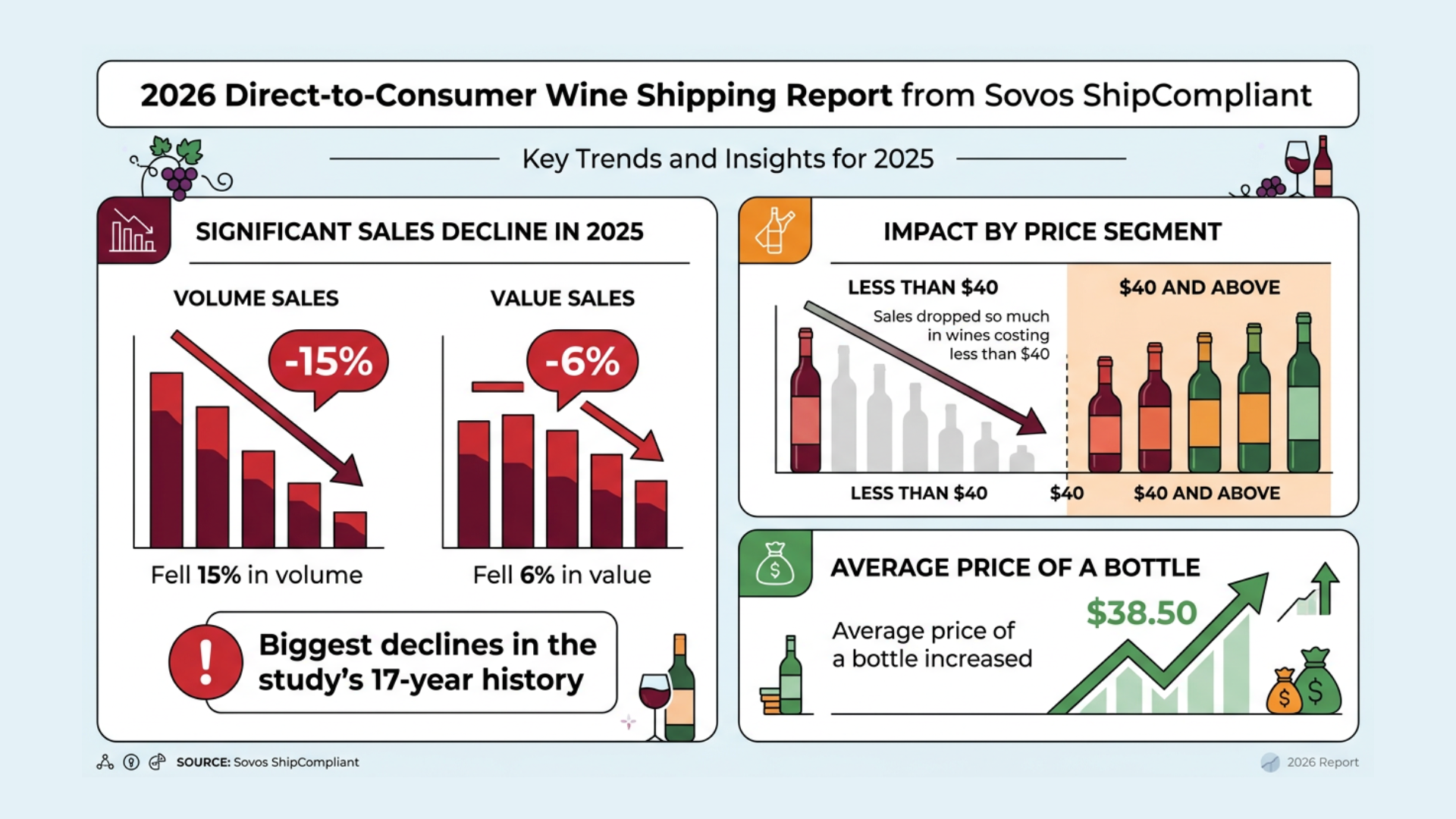 by the report showed lower volumes from 2024. This was the fourth consecutive drop in volume and the second consecutive drop in value.
The average price of a bottle sold via DtC was $56.78, up 11% from last year, even though volume sales were so much lower. This means that although significantly fewer bottles of wine were sold, the ones that were sold were much more expensive.
This anomaly, says Jason Haas of Paso Robles’ Tablas Creek, points to a way to steady DtC sales.
“There’s a mismatch between what we’re making and what the new generation of wine lovers is wanting,” says Haas, whose winery sells 60% of its 30,000-case production via DtC, but where sales were flat last year. “We have to help them find where the cool stuff is, since they don’t buy the same kinds of wines as the Baby Boomers.” Until then, say analysts, it’s likely going to be more bad news.
Ayumi Wonder & Dine – The 750ml Wine Bottle Is Outdated — And Solo Drinkers Know It
Ayumi at Wonder & Dine argues that the traditional 750 ml wine bottle no longer aligns with how many modern consumers drink wine, especially solo drinkers. Drawing on personal experience as someone who regularly enjoys wine at home, the author explains that a 750 ml bottle often holds more wine than a single person can comfortably finish in one sitting. Once opened, the remaining wine quickly loses freshness, making the ritual of opening a bottle less rewarding for those drinking alone. From the Article:
For a solo drinker, 750ml is simply too much.
I usually drink about one-third to half a bottle in an evening. The rest goes back into the fridge.
The next day, it’s still drinkable — but it’s no longer exciting.
Because once a bottle is opened, the clock starts ticking. What begins as “breathing” quickly turns into slow flavour loss.
She argues that –
The sweet spot sits around 400–500ml.
For consumers, this size would mean:
Triad City Beat – The Rise of Water Menus: How Fine Dining Is Treating Water Like Wine
In a guest post on Triad City Beat, the staff reports that restaurants are increasingly elevating water to a curated tasting experience, placing water menus alongside wine lists and sommeliers who guide diners through mineral profiles, origins, and pairing suggestions, much like a wine program. This trend reflects a broader shift toward non-alcoholic luxury beverages and a focus on terroir, minerality, and palate experience that goes beyond mere thirst-quenching. From the Article:
Water is water, right? But sommeliers and chefs across the country are pushing back on that idea, arguing that the differences between waters are just as real as the differences between wines. And diners are starting to pay attention.
The soil, the altitude, the climate. Water, it turns out, works the same way. A spring filtered through volcanic rock in Iceland tastes nothing like one that flows through limestone in the Italian Alps. The mineral content is different. The mouthfeel is different. Even the way it pairs with food changes depending on where it came from and what it picked up along the way.
Cordon of Santa Barbara Winery
Cordon of Santa Barbara offers a focused exploration of Santa Barbara County terroir from its tasting room in downtown Solvang. Founded by Etienne Terlinden, the winery emphasizes site-specific expressions of Rhône and Burgundian varieties. The portfolio highlights balanced winemaking and technical precision, delivering wines that reflect the diverse microclimates of the region.
2022 Bouches-du-Rhône Blanc “Baume Noire”

This limited-production white wine breaks from local tradition as a pure Vermentino aged in sandstone amphorae. Grown on the sea-swept cliffs of Cap Canaille, it offers a distinctively saline and textured experience. It combines organic farming with precise winemaking to highlight the mineral intensity of the Mediterranean coast.
Bar Le Côte: Coastal Cuisine and Spanish Influences in Los Olivos

Located in Los Olivos, this seafood tavern presents a menu rooted in Spanish and Portuguese traditions. While the “Dinner for Two” tasting menu showcases high-quality ingredients and strong sourcing, execution across the courses varied during our visit. The casual setting pairs well with its maritime focus.