
UPI – 416-year-old grapevine in Tibet is officially the oldest in the world
And from UPI, Ben Hooper kicks off our news today with a wonderfully odd bit of wine-adjacent news: Guinness World Records has officially crowned a 416-year-old grapevine in Tibet as the oldest wild living vine on Earth. Growing at nearly 7,900 feet in the mountains of Zogang County, this ancient giant stands 26 feet tall
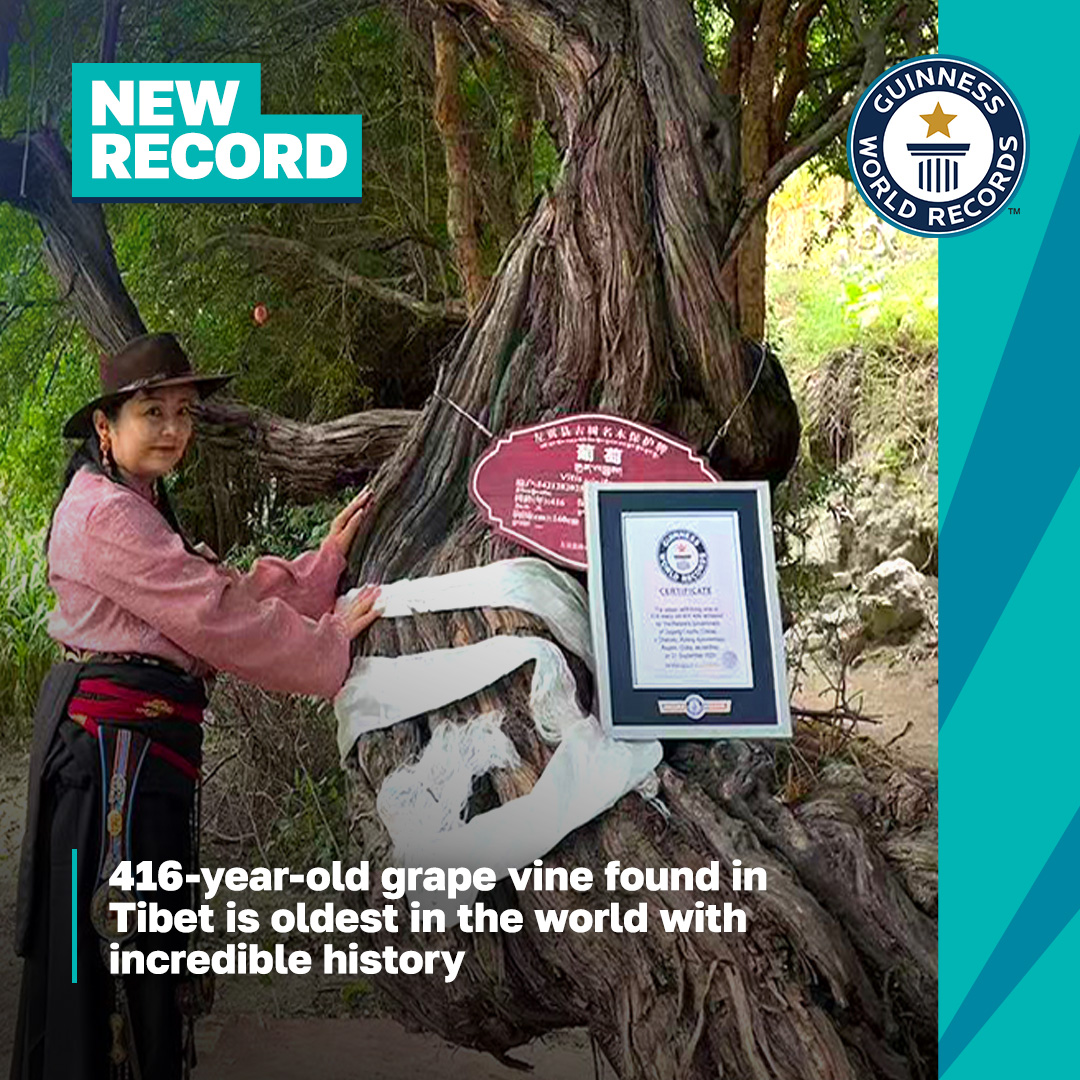
and has a diameter of more than 2 feet. It turns out the world’s true heritage vine isn’t in Europe at all — it’s clinging to a cliffside in Tibet. ChatGPT gave me this reply after a deep dive to discover the varietal:
Short answer: We don’t know, and nobody reputable is saying yet.
I checked beyond the UPI blurb and went into the primary and regional coverage:
Guinness World Records’ own write-up just calls it a “wild grapevine” and gives the age, size, and location—no species or varietal name.
Tibetan Review, Online Indus, and other regional re-reports repeat that it’s a wild red grape from an area dubbed “The Hometown of China’s Wild Red Grapes,” but again, no specific Vitis species or varietal.
There are wild Chinese grape species (like Vitis chungii, Vitis amurensis, etc.), but none of the scientific or news coverage I can see actually links this particular vine to a named species. Any attempt to label it “X grape” or tie it to a vinifera variety would be guesswork.
So, as of what’s publicly available right now, the grape varietal hasn’t been disclosed—only that it’s a 416-year-old wild grapevine in Zogang County, Tibet.
Napa County Times – Napa Valley Grapes Were Left On The Vine This Harvest, While Acres Of Vineyards Have Been Pulled Over The Past Year
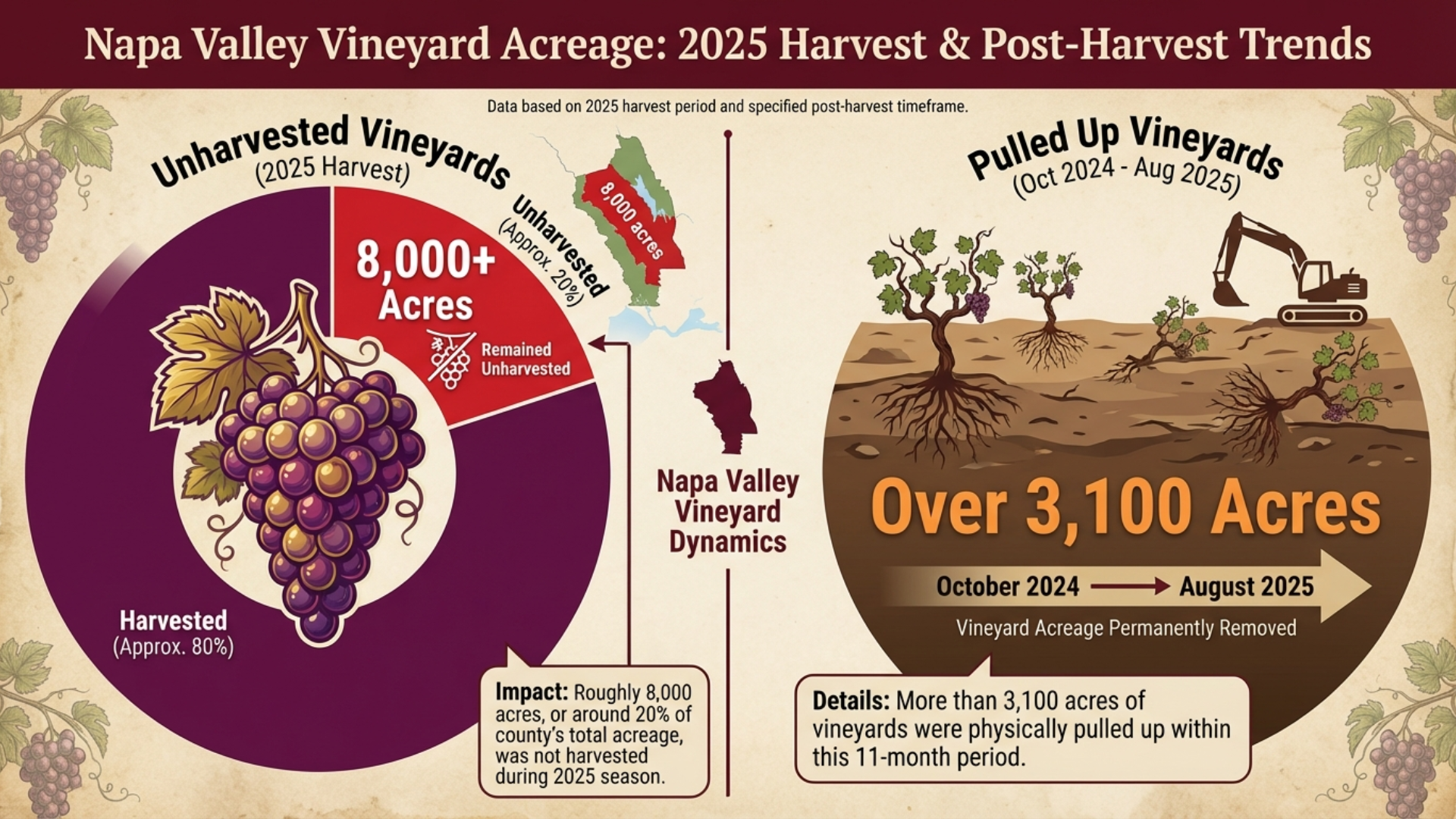
In the Napa County Times, Kerana Todorov reports a troubling shift in the heart of California’s premium wine country: during the 2025 harvest, roughly 8,000 acres of Napa Valley vineyards—around 20% of the county’s acreage—remained unharvested, while over 3,100 acres of vineyards were pulled up between October 2024 and August 2025. Growers cite a combination of fruit oversupply, weak demand, and strategic quality-driven decisions for leaving grapes on the vine and ripping out vines entirely. From the Article:
There are many reasons why these grapes were not harvested, both said. The 2023 and 2024 vintages were heavy, Koschitzky noted. The situation has created opportunities to cherry-pick fruit in the vineyard to elevate quality,” he noted.
Megan Gunderson, vice president of winemaking at Hall, also spoke at the press conference. Hall did not harvest all of its own fruit this year, she said, and contracted fruit did not meet the proper level of ripeness.
“We’re making sure that our inventory levels are appropriate and we also want to make the very best wine,” Gunderson said. “And so, where we harvested and where we didn’t was very influenced by quality as well.”
Wine-Searcher – Are We There Yet? Wine’s Search for Rock Bottom
And for a much deeper dive into the issues. W. Blake Gray over at Wine-Searcher, explores the troubling state of the U.S. wine industry and asks the big question: how low can it go? Citing experts like Jon Moramarco, Rob McMillan, Jeff Bitter and Dale Stratton, the piece outlines vineyard rip-outs, unsold inventory and collapsing demand—and debates whether we’re already at “rock bottom” or still heading there. From the Article:
 First, a little background on why I’m asking the question.
We’ve all read many stories of the Wine Market Apocalypse over the last year but one last week hit me harder than most. In 2019, I visited Red Mountain in Washington state and called it “one of the trendiest AVAs in the United States”. The Aquilinis, a billionaire family from Canada, are the world’s largest farmers of blueberries and cranberries. They bought about 12 percent of Red Mountain at auction and had an ambitious program to make great wine there, and they have a chain of restaurants in Canada where they can sell it.
Last week we learned from journalist Sean Sullivan that the Aquilinis simply stopped production in the middle of harvest. I have a feeling my friends in Walla Walla will tell me quietly “mistakes were made”, but the Aquilinis spent tens of millions of dollars on their Washington wine business – possibly hundreds of millions – and they’re just walking away.
OPB – In Oregon’s Star Wine Region, Climate Change Is Challenging Pinot Noir’s Dominance
In OPB (Oregon Public Broadcasting), Branden Andersen reports that climate change is reshaping Oregon’s Willamette Valley and beginning to challenge Pinot Noir’s dominance in the region. Earlier, hotter, and drier growing seasons are pushing harvests weeks ahead of historical norms, forcing winemakers like Bree and Chad Stock of Limited Addition Wines to experiment with varieties such as Cabernet Franc and rethink what the “classic” Willamette profile will be in the coming decades. From the Article:
The Stocks’ Limited Addition Wines is also focused on alternative grapes. Bree Stock, the Pacific Northwest’s first and only female Master of Wine, said she’s experimenting with several varieties, but cabernet franc has her attention.
She called cabernet franc an “unsung hero” in the Willamette Valley. Traditionally a warm-weather grape, it develops its signature green pepper and mint character in drier regions such as Yakima, Walla Walla and the Columbia Valley.
In the Willamette Valley, however, the grape ripens later and slower, allowing for balanced sugar and acid development — and more complex wines.
Barton Family Wines in Paso Robles, CA
A true Westside Paso original with three distinct labels—Grey Wolf, Barton, and GREY—Barton Family Wines blends family history, small-lot craft, and a playful, hospitality-forward campus (kitchen + distillery) into one polished destination. Expect inventive Rhône/Bordeaux-leaning blends under Grey Wolf, reserve reds and focused whites under Barton, and a sleek, modern, limited line under GREY—each with its own personality, all tied together by Joe Barton’s house style
2020 Domaine du Grand Tinel Châteauneuf-du-Pape

A ripe, classically CdP profile—black cherry and plum wrapped in smoke and pepper—delivered on a full-bodied frame with a long, cohesive finish. The 60/40 Grenache-Syrah blend shows old-vine depth and the hallmark mineral imprint of galets roulés

A Michelin Bib Gourmand treasure in Civitavecchia, Forma blends contemporary Italian creativity with heartfelt hospitality, offering innovative seafood, meat, and vegan dishes in a chic, historic setting.